Today's
EarthStation1.com 15% (Or More!) Off Commemorative Memorial Title:
Why We Fight All 8 Episodes Of All 7 Films DVD MP4 Download USB
Drive
Today, September 15, 2026
September 15: International Day Of
Democracy: -- An opportunity to celebrate and appreciate our
democratic society. It's very easy for people who live in a free
society to take their freedoms for granted. Yet, when freedom is
absent, life includes unimaginable challenges that are often
incomprehensible. Today, let's reflect on the history of democracy
around the world, thank those who influenced the development of
our government, and look for opportunities to promote and protect
our own nation's democracy. The United Nations (UN) General
Assembly passed a resolution in 2007 that September 15 of each
year would be observed as the International Day of Democracy.
Their goal for this day is to promote government's role in
maintaining open democracy among all member nations of the UN
Charter and to celebrate the system of values democracy promotes,
giving citizens the power to make decisions regarding all aspects
of their lives. In their efforts to advocate for democratic
societies around the world, the UN serves a variety of purposes
including monitoring elections, working to strengthen democratic
institutions and accountability, and assisting nations recovering
from conflict to create their own constitution. From democracy's
birth in ancient Greece thousands of years ago to today, the
foundation of a democratic society is the ability of its people to
participate in the decision-making process of their nation. This
can only happen when everyone is allowed to vote regardless of
race, gender or other factors meaning inclusion and equality are
also important to the success of a democratic society. In America,
we have a representative democracy meaning we elect officials to
represent our collective voice to vote on decisions. As you
reflect on your own freedoms and consider the country's current
state of democracy, take inventory of how many ways you
participate in the collective-decision making of our country, and
support the ideals of democracy. On Sale Until Midnight Tonight
PT!
https://store.earthstation1.com/why-we-fight-dvds-all-8-episodes-of-all-7-films-5-di875.html
Today's
EarthStation1.com 15% (Or More!) Off Commemorative Memorial Title:
Legacy With Michael Wood World History TV Series DVD, MP4, USB
Stick
Today, September 15, 2026
September 15: National Hispanic Heritage
Month (Spanish: Mes Nacional De La Herencia Hispana): -- A
celebration that begins on the September 15, 1821 anniversary of
the Central American countries of Guatemala, El Salvador,
Honduras, Nicaragua, and Costa Rica jointly declaring independence
from Spain, and lasts until October 15 in the United States.
National Hispanic Heritage Month recognizes the contributions and
influence of Hispanic Americans to the history, culture, and
achievements of the United States. There is certainly too much
about Hispanic culture to keep it all to just the one day, so the
celebrations are now spread out across an entire month. That means
there is plenty of time to enjoy all of the best things about
being Hispanic, from the food and music, to the fashion and way of
life. Even if you aren't of Hispanic or Latino descent yourself,
there will still be plenty that you can enjoy in this busy month.
There are many exhibitions and events held throughout the whole of
Hispanic Heritage Month, so there will certainly be something that
interests you to get involved with. Even if you don't live near
any events, you will be able to celebrate in your own home. Many
galleries and museums showcase exhibitions of Hispanic and Latino
artworks and notable artifacts. Many cultural centers and music
venues will also host special concerts and theater shows to show
off some of the best of Hispanic and Latino culture as well. There
are also many great food events as well, including street food
markets and festivals, as well as sophisticated supper clubs and
restaurant nights. Even if you can't get involved with any of
these public events, you will still be able to celebrate Hispanic
Heritage Month by cooking up some delicious Hispanic and Latino
dishes and meals in your own home. Another great way to get
involved with Hispanic Heritage Month is to join in the discussion
on social media. Many major figures from the Hispanic and Latino
communities are regularly vocal on the likes of Twitter, and
especially so in this important month. Joining in with the
discussion is a great way to find out more and learn as much as
possible about these significant ethnicities. As you can see,
Hispanic Heritage Month is a great way to immerse yourself into
some new culture and to learn a lot about this fantastic
community. It's also a great excuse to enjoy a Latin party as
well! So, where did Hispanic Heritage Month all begin? Well, it
dates back to 1968 when a Hispanic Heritage Week was created under
President Lyndon Johnson. It was then expanded to encompass a
whole month in 1988 by President Ronald Reagan. Thanks to now
being a whole month, the four weeks cover the anniversary of
independence for many Latin countries, including Costa Rica,
Guatemala, and El Salvador amongst a few others. Since its
inception, the Hispanic Heritage Month has become a huge deal in
the calendar of many Hispanic and Latino people around the world,
and it is celebrated by hundreds of thousands of people,
regardless of where they might be in the world. On Sale Until
Midnight Tonight PT!
https://store.earthstation1.com/legacy-with-michael-wood-world-history-tv-series-dvd-mp4-us4.html
Today's
EarthStation1.com 15% (Or More!) Off Commemorative Memorial Title:
Air Marshal Dowding: The Battle Of Britain 1940 DVD, Download, USB
Today, September 15, 2026
September 15: Battle Of Britain Day: --
September 15, 1940: The European Civil War: World War II: The
Second European War (The European Theater Of World War II):
Aviation: Military Aviation: Air Warfare Of World War II: The
Battle Of Britain: Strategic Bombing During World War II: European
Air Operations During The Battle Of Europe: German Strategic
Bombing During World War II: European Air Operations During The
Battle Of Europe: The Blitz: -- The last massive daytime German
air raids of the Battle Of Britain occur during the climax of the
battle against London, Southampton, Bristol, Cardiff, Liverpool
and Manchester. The British claimed 185 German planes were shot
down. Fighter pilot Raymond Towers "Ray" Holmes saves
Buckingham Palace from being hit by German bombing, when he used
his Hawker Hurricane to destroy a Dornier Do-17 bomber over London
by ramming but at the loss of his own aircraft (and almost his own
life) in one of the defining moments of the Battle Of Britain. He
was feted by the press as a war hero for his saving of Buckingham
Palace. The British pilot became a King's Messenger after the war,
and died at the age of 90 in 2005. Battle Of Britain Day is the
name given to this day. Around 1,500 aircraft took part in the air
battles which lasted until dusk. In the aftermath of the raid,
Hitler postponed 2Operation Sea Lion, the planned German invasion
of Britain. Having been defeated in daylight, the Luftwaffe turned
its attention to The Blitz night campaign which lasted until May
1941. Battle Of Britain Day is now an annual commemoration of the
battle in the United Kingdom on September 15; in Canada, the
commemoration takes place on the third Sunday of September. After
the German victory in the Battle Of France 25 June, 1940, initial
Luftwaffe estimates were that it would take four days to defeat
the RAF Fighter Command in southern England. This would be
followed by a four-week offensive during which the bombers and
long-range fighters would destroy all military installations
throughout the country and wreck the British aircraft industry.
The campaign was planned to begin with attacks on airfields near
the coast, gradually moving inland to attack the ring of sector
airfields defending London. Later reassessments gave the Luftwaffe
five weeks, from August 8 to September 15, to establish temporary
air superiority over England. To achieve this goal, Fighter
Command had to be destroyed, either on the ground or in the air,
yet the Luftwaffe had to be able to preserve its own strength to
be able to support the invasion; this meant that the Luftwaffe had
to maintain a high "kill ratio" over the RAF fighters.
The only alternative to the goal of air superiority was a terror
bombing campaign aimed at the civilian population, but this was
considered a last resort and it was (at this stage of the battle)
expressly forbidden by Hitler. The Luftwaffe kept broadly to this
scheme, but its commanders had differences of opinion on strategy.
Sperrle wanted to eradicate the air defence infrastructure by
bombing it. His counterpart, Kesselring, championed attacking
London directly- either to bombard the British government into
submission, or to draw RAF fighters into a decisive battle. Goring
did nothing to resolve this disagreement between his commanders,
and only vague directives were set down during the initial stages
of the battle, with Goring seemingly unable to decide upon which
strategy to pursue. He seemed at times obsessed with maintaining
his own power base in the Luftwaffe and indulging his outdated
beliefs on air fighting, which would later lead to tactical and
strategic errors. On 14 September, Hitler chaired a meeting with
the OKW staff. Goring was in France directing the decisive battle,
so Erhard Milch deputised for him. Hitler asked "Should we
call it off altogether?" General Hans Jeschonnek, Luftwaffe
Chief Of Staff, begged for a last chance to defeat the RAF and for
permission to launch attacks on civilian residential areas to
cause mass panic. Hitler refused the latter, perhaps unaware of
how much damage had already been done to civilian targets. He
reserved for himself the power to unleash the terror weapon.
Instead political will was to be broken by destroying the material
infrastructure, the weapons industry, and stocks of fuel and food.
On 15 September, two massive waves of German attacks were
decisively repulsed by the RAF by deploying every aircraft in 11
Group. Sixty German and twenty-six RAF aircraft were shot down.
Two days after the German defeat Hitler postponed preparations for
the invasion of Britain. Henceforth, in the face of mounting
losses in men, aircraft and the lack of adequate replacements, the
Luftwaffe completed their gradual shift from daylight bomber raids
and continued with nighttime bombing. British morale was to be
broken by destroying infrastructure, armaments manufacturing, fuel
and food stocks. On 16 September, Goring gave the order for this
change in strategy. This new phase was to be the first independent
strategic bombing campaign, in hopes of a political success
forcing the British to give up. Hitler hoped it might result in
"eight million going mad" (referring to the population
of London in 1940), which would "cause a catastrophe"
for the British. In those circumstances, Hitler said, "even a
small invasion might go a long way". Hitler was against
cancelling the invasion as "the cancellation would reach the
ears of the enemy and strengthen his resolve".On 19
September, Hitler ordered a reduction in work on Sealion. He
doubted if strategic bombing could achieve its aims, but ending
the air war would be an open admission of defeat. He had to
maintain the appearance of concentration on defeating Britain, to
conceal from Joseph Stalin his covert aim to invade the Soviet
Union. On Sale Until Midnight Tonight PT!
https://store.earthstation1.com/air-marshal-dowding-the-battle-of-britain-19401940.html
Today's
EarthStation1.com 15% (Or More!) Off Commemorative Memorial Title:
TV Commercials: The Classics Vol. 5 DVD, Video Download, USB Drive
Today, September 15, 2026
September 15: National Double
Cheeseburger Day: One of America's favorites, National Double
Cheeseburger Day recognizes a food icon savored across the United
States. Hamburger. Seasoned ground beef, grilled and placed
between two slices of bread or a bun. Top with sauteed onions,
peppers, pickles, sliced onions, and cheese. Add condiments such
as ketchup, mustard, or mayo. Any one of these combinations would
create a modern American version a hamburger. Now, double the
patties and the cheese. The celebration requires it. While the day
is about the double cheeseburger, that doesn't mean you can't add
your favorite toppings. When it comes to adding some tanginess to
a burger, a few ingredients never fail. Goat cheese brightens a
burger every time. But if you're looking for a crispness, too, add
some creamy coleslaw instead. Another option in this category is
the reliable tartar sauce. If you like to bring the heat, you can
look to your cheeses. Pepper jack is a mild way of adding some
spice. However, if you prefer to test the limits, fresh sliced
jalapenos or habaneros will also do the trick. It is most likely
that the hamburger sandwich first appeared in the 19th or early
20th centuries, but there is much controversy over its origin.
Over the years, the hamburger has become a culinary icon in the
United States. And Americans love their burgers! Restaurants
dedicated to making them just right have been in business for
generations. Even those who refrain from red meat don't hesitate
to find a way to enjoy a juicy burger. Whether the burger is
charbroiled, grilled or barely kisses the heat, there's a flavor
for you. So when something this delicious exists, double it! Then
celebrate it! To observe National Double Cheeseburger Day, enjoy a
delicious double cheeseburger. Add your favorite toppings. Since
it's a celebration, be sure to invite friends to join you. Whether
you cook together or go out to eat, remember to #CelebrateEveryDay
and share your meal using #DoubleCheeseburgerDay to post on social
media. On Sale Until Midnight Tonight PT!
https://store.earthstation1.com/tv-commercials-the-classics-vol-5-dv5.html
Today's
EarthStation1.com 15% (Or More!) Off Commemorative Memorial Title:
American Anti-Drug Films & Broadcasts Set MP4 Video Download 2
DVD Set
Today, September 15, 2026
September 15: D.A.R.E. Day: -- Today we
observe Drug Abuse Resistance Education (D.A.R.E.) Day, created as
a collective effort to bring attention to a social cause. Drug
abuse is a recurrent issue in many countries, and one of the
leading causes of death. Several initiatives and educational
programs have been organized during the last few decades to
prevent drug abuse, and this special observance day is one of such
efforts. In the early 1980s, drugs became a noticeable issue in
many inner cities. During that period, several government programs
were organized in response, but as policies changed, drug abuse
remained a consistent issue, requiring a different approach.
Prevention is one of the most commonly used methods in response to
drug abuse, and this is the basis for the Drug Abuse Resistance
Education programs. The D.A.R.E. program was developed by the Los
Angeles Police Department to educate people. As it proved
successful, other cities adopted similar approaches, and soon
enough, D.A.R.E. programs became a national standard applied in
schools across the U.S. The program caught the attention of
then-president Ronald Reagan, who announced the first national
celebration of D.A.R.E. Day. At the height of their existence,
D.A.R.E. programs were funded by the federal government and
commissioned by the Drug-Free Schools and Communities Act. Many
schools still organize D.A.R.E. programs, but as of today, several
studies on the effectiveness of some methods used in the programs
have led to alterations. Despite the numerous changes to the
programs, D.A.R.E. Day is still a nationwide celebration with
educational activities organized to commemorate it each year, and
the main message of prevention of drug addiction and abuse still
resonates. On Sale Until Midnight Tonight PT!
https://store.earthstation1.com/classic-american-antidrug-films-2-dual-layer-dvd-se3.html
Today's
EarthStation1.com 15% (Or More!) Off Commemorative Memorial Title:
To Engineer Is Human: Engineering Disasters DVD, Download, USB
Drive
Today, September 15, 2026
September 15: World Engineers Day: --
World Engineers Day, celebrated every September 15, serves to
appreciate engineers and their contributions to society. Engineers
are professionals who invent, design, and build complex systems,
structures, and materials in order to fulfill functional
objectives and deliverables, keeping in mind factors such as
practicality, regulation, safety, and cost. The word 'engineer' is
derived from the Latin words 'ingeniare' (which means 'to create
or generate') and 'ingenium' (which means 'cleverness'). An
engineer typically would require foundational qualifications of a
four-year bachelor's degree in any of several engineering
disciplines - or, in certain peculiar jurisdictions, a master's
degree in an engineering discipline with an addition of four to
six years of peer-reviewed professional practice, which would then
result in a thesis, and then, conclusively, a passing of
engineering board examinations. The inventions of Thomas Savery
and James Watt laid the foundation of modern mechanical
engineering. The development of specialized machines, as well as
the maintenance of these tools during the Industrial Revolution,
gave rise to the rapid expansion of mechanical engineering in its
birthplace of Britain and beyond. The field of electrical
engineering was marked and impacted by the experiments of
Alessandro Volta in the 19th century. Other major contributions to
the development of the discipline were the experiments of Michael
Faraday, Georg Ohm, and others - as well as the groundbreaking
invention of the electric motor in 1872. This field of engineering
eventually became a profession late in the 19th century.
Electrical engineers had built a global electric telegraph network
and the first electrical engineering institutions backing this
discipline were established in the United States and the United
Kingdom. While it is difficult to name the first electrical
engineer with certainty, it is noteworthy that Francis Ronalds was
a standout individual in the field, having created the first
working electric telegraph system in 1816 and documented a
personal vision of the transformation of the world by electricity.
The field of electronics was founded in the late 19th century
through the work of James Maxwell and Heinrich Hertz. The eventual
inventions of the vacuum tube and the transistor would further
bolster the development of electronics to the extent that
practitioners of electrical and electronics engineering currently
outnumber any other engineering specialty. Chemical engineering
also developed in the 19th century, during the Industrial
Revolution. With the increase in need, and invariably demand, for
large-scale chemical production came the creation of an entirely
new industry: chemical engineering. On Sale Until Midnight Tonight
PT!
https://store.earthstation1.com/to-engineer-is-human-dvd-great-engineering-disasters.html
Today's
EarthStation1.com 15% (Or More!) Off Commemorative Memorial Title:
Nuclear War Films #14 Operations Cannikin, Plowshare DVD Download
USB
Today, September 15, 2026
September 15: Greenpeace Day: --
September 15, 1971: The first Greenpeace ship sets sail to protest
against Project Cannikin, the Atomic Energy Commission's 1971
series of underground nuclear tests conducted on Amchitka Island.
In commemoration of this event, Greenpeace Day is observed every
year on September 15. It is a day dedicated to bringing about a
change in the way we treat our environment. It calls for peaceful
protests to improve the air that we breathe, reduce the dependency
on fossil fuels, avoiding the usage of plastic, and improving the
water quality. Greenpeace undertakes various campaigns to this
effect to spread awareness of these concerns. Despite this
protest, Project Cannikin commenced at at 11:00 a.m., Bering
Standard Time, on November 6, 1971. It's purpose was to test the
design of the Spartan anti-ballistic missile, itself a high-yield
nuclear warhead that produced sufficient x-rays and debris to
prevent the blackout of ABM radar systems. On Sale Until Midnight
Tonight PT!
https://store.earthstation1.com/nuclear-war-films-14-dvd-operations-cannikin-amp-plowsha14.html
Today's
EarthStation1.com 15% (Or More!) Off Commemorative Memorial Title:
Soldiers: A History Of Men In Battle TV Series + Bonus Title DVD
MP4
Today, September 15, 2026
September 15, 1916: The European Civil
War: World War I: The First European War (The European Theater Of
World War I): The Western Front Of World War I: The Battle Of The
Somme (The Somme Offensive, The First Battle Of The Somme): The
Battle Of Flers-Courcelette: -- Tanks are used in combat for the
first time as the British send thirty-two British Mark I tanks,
the world's first tanks, into battle during the Allied offensive
at the the Battle Of Flers-Courcelette, a part of the Battle Of
The Somme. Results were mixed; many broke down, but nearly a third
succeeded in breaking through. Of the forty-nine tanks shipped to
the Somme, only thirty-two were able to begin the first attack in
which they were used and only nine made it across "no man's
land" to the German lines. The tanks had been rushed into
combat before the design was mature enough (against First Lord of
the Admiralty Winston Churchill's and Major-General Sir Ernest
Dunlop Swinton's wishes, each of whom played an important part in
the development and adoption of the tank) and the number was small
but their use gave important feedback on how to design newer
tanks, the soundness of the concept, and their potential to affect
the course of the war. On the other hand, the French Army was
critical of the British employment of small numbers of tanks at
this battle. They felt the British had sacrificed the secrecy of
the weapon while employing it in numbers too small to be decisive.
Considering that the British attack was part of an Anglo-French
offensive while the Russians were also attacking at the same time,
Haig felt justified in making a maximum effort, regardless of the
limitations of the tank force. The Mark Is were capable of
performing on the real battlefield of World War I, one of the most
difficult battlefield terrains ever. They did have reliability
problems, but when they were working they could cross trenches or
craters of 9 feet (2.7 m) and drive right through barbed wire. It
was still common for them to get stuck, especially in larger bomb
craters, but overall the rhomboid shape allowed for extreme
terrain mobility. Tank crews who had read press reports depicting
the new weapon driving through buildings and trees, and crossing
wide rivers, were disappointed. Most World War I tanks could
travel only at about a walking pace at best. Their steel armour
could stop small arms fire and fragments from high-explosive
artillery shells. However they were vulnerable to a direct hit
from artillery and mortar shells. The environment inside was
extremely unpleasant; as ventilation was inadequate the atmosphere
was heavy with poisonous carbon monoxide from the engine and
firing the weapons, fuel and oil vapours from the engine and
cordite fumes from the weapons. Temperatures inside could reach
50dg C (122dg F). Entire crews lost consciousness inside the
tanks, or collapsed when again exposed to fresh air. Crews learned
how to create and leave behind supply dumps of fuel, motor oil,
and tread grease, and converted obsolete models into supply
vehicles for newer ones. To counter the danger of bullet splash or
fragments knocked off the inside of the hull, the crew wore
helmets with goggles and chainmail masks. Fragments were not as
dangerous as fire, because of explosive fumes and the large amount
of fuel aboard; smoking was prohibited inside and within 20 yards
outside tanks. Gas masks were also standard issue, as they were to
all soldiers at this point in the war due to the use of chemical
warfare. The side armour of 8 mm initially made them largely
immune to small arms fire, but could be penetrated by the recently
developed armour-piercing K bullets. There was also the danger of
being overrun by infantry and attacked with grenades. The next
generation had thicker armour, making them nearly immune to the K
bullets. In response, the Germans developed a larger purpose-made
anti-tank rifle, the 3.7 cm TAK 1918 anti-tank gun, and also a
Geballte Ladung ("Bunched Charge")-several regular stick
grenades bundled together for a much bigger explosion. Engine
power was a primary limitation on the tanks; the roughly one
hundred horsepower engines gave a power-to-weight ratio of 3.3
hp/ton (2.5 kW/ton). By the end of the 20th century,
power-to-weight ratios exceeded 20 hp/ton (15 kW/ton). Many feel
that because the British Commander Field Marshal Douglas Haig was
himself a horse cavalryman, his command failed to appreciate the
value of tanks. In fact, horse cavalry doctrine in World War I was
to "follow up a breakthrough with harassing attacks in the
rear", but there were no breakthroughs on the Western Front
until the tanks came along. Despite these supposed views of Haig,
he made an order for 1,000 tanks shortly after the failure at the
Somme and always remained firmly in favour of further production.
In 1919, Major General Sir Louis Jackson said: "The tank was
a freak. The circumstances which called it into existence were
exceptional and not likely to recur. If they do, they can be dealt
with by other means." The Battle of Flers-Courcelette (15-22
September 1916) was fought during the Battle Of The Somme in
France, by the French Sixth Army and the British Fourth Army and
Reserve Army, against the German 1st Army, during the First World
War. The Anglo-French attack of 15 September began the third
period of the Battle Of The Somme but by its conclusion on 22
September, the strategic objective of a decisive victory had not
been achieved. The infliction of many casualties on the German
front divisions and the capture of the villages of Courcelette,
Martinpuich and Flers had been a considerable tactical victory but
the German defensive success on the British right flank, made
exploitation and the use of cavalry impossible. Tanks were used in
battle for the first time in history and the Canadian Corps and
the New Zealand Division fought for the first time on the Somme.
On 16 September, Jagdstaffel 2, a specialist fighter squadron,
began operations with five new Albatros D.I fighters, which were
capable of challenging British air supremacy for the first time
since the beginning of the battle. The attempt to advance deeply
on the right and pivot on the left failed but the British gained
about 2,500 yd (2,300 m) in general and captured High Wood, moving
forward about 3,500 yd (3,200 m) in the centre, beyond Flers and
Courcelette. The Fourth Army crossed Bazentin Ridge, which exposed
the German rear-slope defences beyond to ground observation and on
18 September, the Quadrilateral, where the British advance had
been frustrated on the right flank, was captured. Arrangements
were begun immediately to follow up the tactical success which,
after supply and weather delays, began on 25 September at the
Battle of Morval; continued by the Reserve Army next day at the
Battle of Thiepval Ridge. In September, the German armies on the
Somme lost about 130,000 casualties, the most costly month of the
battle. Combined with the losses at Verdun and on the Eastern
Front, the German Empire was brought closer to military collapse
than at any time before the autumn of 1918. On Sale Until Midnight
Tonight PT!
https://store.earthstation1.com/soldiers-a-history-of-men-in-battle-4-dvds-all-13-sh413.html
Today's
EarthStation1.com 15% (Or More!) Off Commemorative Memorial Title:
From Nuremberg To Nuremberg 2 Part WWII TV Series DVD MP4 USB
Drive
Today, September 15, 2026
September 15, 1935: The Interwar Period
(The Aftermath Of World War I, The Interbellum, Between The Wars):
The Road To War: Nazi Germany (The German Reich, The Third Reich):
Nazi Eugenics ("Racial Hygiene"): Racism: Bigotry:
Antisemitism: Jewish Germans (German Jews): Jewish German History
(German Jewish History): The Nuremburg Laws (German: Nurnberger
Gesetze): -- The Nazis enact two antisemitic and racial laws at a
special meeting of the Reichstag convened during the annual
Nuremberg Rally of the Nazi Party (NSDAP) that became known in
infamy as The Nuremburg Laws (German: Nurnberger Gesetze): 1) The
Law For The Protection Of German Blood And German Honour, which
forbade marriages and extramarital intercourse between Jews and
Germans and the employment of German females under 45 in Jewish
households; and 2) The Reich Citizenship Law, which declared that
only those of German or related blood were eligible to be Reich
citizens; the remainder were classed as state subjects, without
citizenship rights. A supplementary decree outlining the
definition of who was Jewish was passed on November 14, 1935, and
the Reich Citizenship Law officially came into force on that date.
The laws were expanded on November 26, 1935 to include Romani
people - known at the time as "Gypsies" - and Black
people. This supplementary decree defined Romanis as "enemies
of the race-based state", the same category as Jews. Out of
foreign policy concerns, prosecutions under the two laws did not
commence until after the 1936 Summer Olympics, held in Berlin. The
Nuremberg Laws had a crippling economic and social impact on the
Jewish community. Persons convicted of violating the marriage laws
were imprisoned, and (subsequent to March 8, 1938) upon completing
their sentences were re-arrested by the Gestapo and sent to Nazi
concentration camps. Non-Jews gradually stopped socialising with
Jews or shopping in Jewish-owned stores, many of which closed due
to lack of customers. As Jews were no longer permitted to work in
the civil service or government-regulated professions such as
medicine and education, many middle class business owners and
professionals were forced to take menial employment. Emigration
was problematic, as Jews were required to remit up to 90 per cent
of their wealth as a tax upon leaving the country. By 1938 it was
almost impossible for potential Jewish emigrants to find a country
willing to take them. Mass deportation schemes such as the
Madagascar Plan proved to be impossible for the Nazis to carry
out, and starting in mid-1941, the German government started mass
exterminations of the Jews of Europe. On Sale Until Midnight
Tonight PT!
https://store.earthstation1.com/from-nuremberg-to-nuremberg-2-part-wwii-tv-series-dvd-mp4-usb-dri24.html
Today's
EarthStation1.com 15% (Or More!) Off Commemorative Memorial Title:
War Jets: The Messerschmitt Me 262 Schwalbe Sturmvogel DVD MP4 USB
Today, September 15, 2026
( #JCKaelin here: I practically never
give an #HBD hashtag to anyone who fought for Nazi Germany - but
this man merits an exception. When I hear Elvis Costello's song
"Goon Squad" about a good man stuck with fighting for
bad people, I think of Herr Steinhoff. Virtually every Allied
soldier who met him after the war held him in the highest personal
as well as professional regard, and he was awarded several times
by those same Allies, including the American Legion Of Merit and
the French Legion Of Honour. I too hold him in such high regard;
in my endless surveying of world history in general, and The
Second World War in particular, I account him one of the great and
good men who, like Yamamoto, deserved to be "cut a break"
;) ). #HappyBirthday, Herr Steinhoff, and thank you for
illuminating me as well as so many of your former, and reconciled,
enemies. ) ========= September 15, 1913: #BOTD: #HBD: Johannes
Steinhoff, nicknamed "Macky", Luftwaffe fighter ace
during World War II, German general, and NATO official (d.
February 21, 1994) is #born in Bottendorf, Province Of Saxony,
Prussia, Germany. He was one of very few Luftwaffe pilots who
survived to fly operationally through the whole of the war period
1939-45 until he was severely burned during a failed take-off of
his Messerschmitt Me 262 jet fighter. Steinhoff was also one of
the highest-scoring pilots with 176 victories, and one of the
first to fly the Messerschmitt Me 262 in combat as a member of the
Jagdverband 44 squadron led by Adolf Galland. Steinhoff was
decorated with the Knight's Cross Of The Iron Cross With Oak
Leaves And Swords during World War II, and after the war, also
received The Grand Cross Of The Order Of Merit Of The Federal
Republic Of Germany (West Germany, modern Germany) and several
foreign awards including the American Legion Of Merit and the
French Legion Of Honour. He played a role in the so-called Fighter
Pilots' Revolt late in the war, when several senior air force
officers confronted Hermann Goering with an ultimatum: cease the
use of the Me-262 as a bomber (a use for which it was never
intended, but in a dream Hitler concluded it was best used as a
bomber instead [resulting in the Me-262's Sturmvogel {"Storm
Bird} variant}, resulting immediately upon waking in his ordering
that it be used exclusively used in that manner) and let us use
the Me-262 as a fighter (the Schwalbe ["Swallow"]
variant], or else we will all to a man commit suicide; this
resulted in Hitler's rescinding his command to use it only as a
bomber, which permitted its use as a fighter, in order to prevent
losing his best fighter pilots. After the war, Steinhoff joined
the West German government's Rearmament Office as a consultant on
military aviation in 1952 and became one of the principal
officials tasked with rebuilding the German Air Force through the
Cold War. With the express written permission of West Germany's
NATO allied, Steinhoff was permitted to wear all the air combat
medals he received during World War II, provided that all Nazi
symbology and references on them were removed. In retirement,
Steinhoff became a widely read author of books on German military
aviation during the Second World War and the experiences of the
German people at that time. Steinhoff died in a Bonn hospital aged
80 from complications arising from a heart attack he suffered the
previous December. He had lived in nearby Bad Godesberg. He is
buried at Wachtberg Villip Village Cemetery in Wachtberg,
Rhein-Sieg-Kreis, Nordrhein-Westfalen, Germany. On Sale Until
Midnight Tonight PT!
https://store.earthstation1.com/war-jets-the-messerschmitt-me-262-schwalbe-262.html
Today's
EarthStation1.com 15% (Or More!) Off Commemorative Memorial Title:
G.I. Diary (1978) Color WWII TV Series DVD, Video Download, USB
Drive
Today, September 15, 2026
September 15, 1944: World War II: The
Pacific War (The Asia-Pacific War, The Asiatic-Pacific Theater,
The Pacific Theater Of World War II): The Pacific Ocean Theater Of
World War II: The Mariana And Palau Islands Campaign (Operation
Forager): The Battle of Peleliu (Operation Stalemate II): --What
The National Museum Of The Marine Corps calls "the bitterest
battle of the war for the Marines" begins as The United
States Marine Corps' 1st Marine Division and the United States
Army's 81st Infantry Division land at beaches codenamed White and
Orange under heavy fire from Japanese infantry and artillery on
the island of Peleliu (or Beliliou), an island southeast of the
Philippines and northwest of New Guineau, part of the Micronesian
island state of Palau in the subregion of Oceania in the western
Pacific, beginning The Battle Of Peleliu (September 15 - November
27, 1944). Yhe 1st Marine Division, and later soldiers of the 81st
Infantry Division, fought to capture an airstrip on the small
coral island. This battle was part of a larger offensive campaign
known as Operation Forager, which ran from June to November 1944,
in the Pacific Theater. Major General William Rupertus, Commander
of the 1st Marine Division, predicted the island would be secured
within four days. However, after repeated Imperial Army defeats in
previous island campaigns, Japan had developed new island-defense
tactics and well-crafted fortifications that allowed stiff
resistance, extending the battle through more than two months. In
the United States, this was a controversial battle because of the
island's questionable strategic value and the high casualty rate,
which exceeded that of all other amphibious operations during the
Pacific War. On Sale Until Midnight Tonight PT!
https://store.earthstation1.com/gi-diary-dvd-set-wwii-in-color-film-all-26-tv-shows-7-di267.html
Today's
EarthStation1.com 15% (Or More!) Off Commemorative Memorial Title:
American Caesar: Douglas MacArthur TV Series DVD, Download, USB
Drive
Today, September 15, 2026
September 15, 1950: Korea: The History Of
Korea: The Aftermath Of World War II: The Cold War: The Cold War
In Asia: The Korean Conflict: The Cold War (1947-1953): The Cold
War In Asia: The Korean War: The Battle Of Inchon (Korean: Incheon
Sangnyuk Jakjeon) (The Battle Of Incheon): -- United States forces
launch an amphibious invasion of the Korean port city of Inchon on
the Yellow Sea, located in the extreme northwestern section of
what is currently South Korea, resulting in a decisive victory and
strategic reversal in favor of the United Nations (UN). The
operation involved some 75,000 troops and 261 naval vessels, and
led to the recapture of the South Korean capital of Seoul two
weeks later. The code name for the operation was Operation
Chromite. The battle lasted from September 15. 1950 until
September 19. Through a surprise amphibious assault far from the
Pusan Perimeter that UN and South Korean forces were desperately
defending, the largely undefended city of Incheon was secured
after being bombed by UN forces. The battle ended a string of
victories over the Korean People's Army (KPA). The subsequent UN
recapture of Seoul partially severed the KPA's supply lines in
South Korea. The UN and South Korean forces were commanded by
General of the Army Douglas MacArthur of the United States Army.
MacArthur was the driving force behind the operation, overcoming
the strong misgivings of more cautious generals to a risky assault
over extremely unfavorable terrain. On Sale Until Midnight Tonight
PT!
https://store.earthstation1.com/american-caesar-douglas-macarthur-tv-series-3-dvds-john-husto3.html
Today's
EarthStation1.com 15% (Or More!) Off Commemorative Memorial Title:
Nikita Khrushchev Biography Documentary Set MP4 Video Download DVD
Today, September 15, 2026
September 15-27, 1959: The Aftermath Of
World War II: The Cold War: The Cold War (1953-1962): Soviet
Union-United States Relations: Soviet Union-United States
Conferences: The State Visit Of Nikita Khrushchev To The United
States (September 15-27, 1959): Day 1, September 15, 1:00 p.m. -
Soviet Premier Nikita Khrushchev, his wife Nina, son Sergei,
daughters Julia and Rada, and son-in-law Alexei Adzhubei land at
Andrews Air Force Base in Maryland, just outside of Washington,
D.C. The state visit of Nikita Khrushchev to the United States was
a 13-day visit from September 15-27, 1959. It marked the first
state visit of a Soviet leader to the US. Khrushchev, then General
Secretary of the Communist Party of the Soviet Union and Chairman
of the Council of Ministers, was also the first ethnic Ukrainian
leader to set foot in the Western Hemisphere. Being the first
visit by a leader of his kind, the coverage of it resulted in an
extended media circus. On Sale Until Midnight Tonight PT!
https://store.earthstation1.com/nikita-khrushchev-documentaries-dvd.html
Today's
EarthStation1.com 15% (Or More!) Off Commemorative Memorial Title:
King: A Filmed Record: Montgomery To Memphis DVD, Download, USB
Drive
Today, September 15, 2026
September 15, 1963: Civil Rights
Movements: The American Civil Rights Movement (1954-1968):
Anti-Black Racism In The United States: The Birmingham Campaign
(The Birmingham Movement, The Birmingham Confrontation): The 16th
Street Baptist Church Bombing: -- #DOTD: #RIP: Four children are
killed in the bombing of an African American church in Birmingham,
Alabama, United States. The 16th Street Baptist Church Bombing was
an act of white supremacist terrorism which occurred at the
African American 16th Street Baptist Church in Birmingham,
Alabama, on Sunday, September 15, 1963, when four members of the
Ku Klux Klan planted at least 15 sticks of dynamite attached to a
timing device beneath the steps located on the east side of the
church. Described by Martin Luther King Jr. as "one of the
most vicious and tragic crimes ever perpetrated against humanity",
the explosion at the church killed four girls and injured 22
others. Although the FBI had concluded in 1965 that the 16th
Street Baptist Church bombing had been committed by four known Ku
Klux Klansmen and segregationists-Thomas Edwin Blanton Jr., Herman
Frank Cash, Robert Edward Chambliss, and Bobby Frank Cherry-no
prosecutions ensued until 1977, when Robert Chambliss was tried
and convicted of the first degree murder of one of the victims,
11-year-old Carol Denise McNair. Thomas Edwin Blanton Jr. and
Bobby Cherry were each convicted of four counts of murder and
sentenced to life imprisonment in 2001 and 2002 respectively,
whereas Herman Cash, who died in 1994, was never charged with his
alleged involvement in the bombing. The 16th Street Baptist Church
bombing marked a turning point in the United States during the
civil rights movement and contributed to support for passage of
the Civil Rights Act Of 1964. On Sale Until Midnight Tonight PT!
https://store.earthstation1.com/king-a-filmed-record--montgomery-to-memphis-dvd.html
Today's
EarthStation1.com 15% (Or More!) Off Commemorative Memorial Title:
Eyes On The Prize II: America At The Racial Crossroads DVD MP4 USB
Today, September 15, 2026
September 15: World Afro Day: -- A day
that celebrates the natural kinky, coiled, or curly hair for
people from black or mixed-race ethnicities. World Afro Day was
founded in an attempt to normalize afros and their natural texture
and end discrimination towards people who wish to wear their hair
in their natural afros. The day also attempts to instill a sense
of pride in people about their hair and remove feelings of shame
that might be associated with tightly coiled and kinky hair. World
Afro Day is celebrated on September 15 worldwide every year. The
day celebrates the natural hair of people from black and
mixed-race ethnicities, normalizes afros, and prevents
discrimination based on hair. When Africans were enslaved, they
were forced to conform to the hairstyles and clothing of their
enslavers. Their natural hair texture was seen as undesirable, so
even after enslaved people were freed, societal pressures forced
them to modify their natural hair. The process of changing
naturally kinky and coiled hair into the straight, smooth hair
that was seen as desirable was not easy. Even today, the process
of straightening and smoothing extremely coiled hair requires
expensive substances that must be applied by professionals. These
chemicals can cause burns, hair loss, and damage to the hair over
time. Apart from the physical damage, people with naturally coiled
hair have faced discrimination because their hair was unfairly
seen as messy or unkempt. This led people to believe that their
hair was not attractive and would also lead to them losing out on
job opportunities as employers would discriminate against them.
With the advent of the Civil Rights movement, more black people
adopted the afro as a simple, easy-to-maintain hairstyle that did
not require them to change the natural texture of their hair.
Today, World Afro Day celebrates the afro and all other hairstyles
worn by black and mixed-race people and all elements of afro hair,
culture, and identity. It also educates people to understand more
about afro hair and hairstyles. On Sale Until Midnight Tonight PT!
https://store.earthstation1.com/eyes-on-the-prize-ii-dvd-set-4-discs-complete-2nd-seri42.html
Today's
EarthStation1.com 15% (Or More!) Off Commemorative Memorial Title:
American Revolutionary War Documentaries DVD, Download, USB Drive
Today, September 15, 2026
September 15, 1776: The Age Of
Enlightenment (The Enlightenment, The Age Of Reason): The Age Of
Revolution: The Atlantic Revolutions: The American Enlightenment:
The American Revolution: The American Revolutionary War: The New
York And New Jersey Campaign: The Landing At Kip's Bay: -- British
forces under General William Howe launch an amphibious landing at
Kip's Bay on the East River shore of Manhattan, north of what then
constituted New York City, resulting in the capture of New York
that very day. Heavy advance fire from British naval forces in the
East River caused the inexperienced militia guarding the landing
area to flee, allowing the British to land. Skirmishes in the
aftermath of the landing resulted in the British capture of some
of those militia. British maneuvers following the landing very
nearly cut off the escape route of some Continental Army forces
stationed further southeast on the island. The flight of American
troops was so rapid that General George Washington, who was
attempting to rally them, was left exposed dangerously close to
British lines. The Landing At Kip's Bay forced the Continental
Army to withdraw to Harlem Heights, ceding control of New York
City on the lower half of the island. General Israel Putnam came
north with some of his troops when the landing began. After
briefly conferring with Washington about the risk of entrapment to
his forces in the city, he rode south to lead their retreat.
There, abandoning supplies and equipment that would slow them
down, his column marched north along the Hudson under the guidance
of his aide Aaron Burr, . The forced march of Putnam's men was so
quick, and the British advance sufficiently slow, that only the
last companies in Putnam's column skirmished with the advancing
British, including Alexander Hamilton's artillery. When Putnam and
his men marched into the main camp at Harlem after dark, they were
greeted by cheers, having been given up for lost. Founding Father
General Henry Knox arrived later after a narrow escape, made
possible by seizing a boat on the Hudson, and he too received an
excited and enthusiastic greeting, and was even embraced by
Washington. Washington then established strong positions on Harlem
Heights. The remaining New York City population were largely
loyalist, and they welcomed the British, pulling down the
Continental Army flag and raising the Union Flag. Howe, who had
wanted to capture New York quickly and with minimal bloodshed,
considered the invasion a complete success. Not wanting to
continue battling with the Americans that day, Howe stopped his
troops short of Harlem. Washington was extremely angry with his
troops' conduct, calling their actions "shameful" and
"scandalous". The Connecticut militia, who already had a
poor reputation, were labeled cowards and held to blame for the
rout. However, others were more circumspect, such as General
William Heath, who said, "The wounds received on Long Island
were yet bleeding; and the officers, if not the men, knew that the
city was not to be defended." The next day, Washington
defended his strong positions on Harlem Heights in a fierce
skirmish between the two armies the following day that became
known as The Battle Of Harlem Heights. After several hours
exchange of musketry, the forces engaged returned to their start
lines, and the position of the two armies on Manhattan remained
relatively unchanged for the next two months, as General Howe,
unwilling to risk a costly frontal attack, did not attempt to
advance further up the island. Having held their own against
picked British troops, the American army received a much needed
boost to their morale after the debacle of the previous day, while
the British acquired a renewed respect for the American ability to
stand and fight. On Sale Until Midnight Tonight PT!
https://store.earthstation1.com/american-revolutionary-war-dvd-documentaries.html
Today's
EarthStation1.com 15% (Or More!) Off Commemorative Memorial Title:
UFOs: The Best Evidence Ever Caught On Tape MP4 Video Download Or
DVD
Today, September 15, 2026
September 15, 1991: Unidentified Flying
Objects (UFOs, Unidentified Anomalous Phenomenon, UAPs): UFO
Incidents (Unidentified Flying Object Incidents): The History Of
Rocketry: The History Of Spaceflight: The Aftermath Of World War
II: The Cold War: The Aftermath Of The Cold War: Space Programs Of
The United States: Human Spaceflight Programs: The Space Shuttle
Program (The Space Transportation System (STS)): Space Shuttle
Mission STS-48: Missile Defense: Missile Defense Systems: The
Strategic Defense Initiative (SDI) (The Star Wars Program): The
STS-48 UFO Incident: The STS-48 UFO Video: -- The apparent firing
of a Strategic Defense Initiative (SDI) "Star Wars"
space weapon at a UFO during the Space Shuttle Discovery's STS-48
mission occurs, an event that was broadcast live on NASA's live
video stream, and was recorded on VHS video tape by several
amateur space enthusiasts; NASA claims to have lost their own
recording of the event. These video tapes record an unidentified
flying object apparently emerging from the Earth's atmospher and
move steadily through the space above the Earth. Then, after a
double flash of light occurs, which NASA contends corresponds to
the firing of one of the Space Shuttle's thrusters, and the
momentary stationary state of the object immediately after the
flashes, a streak of light shoots across the sky towards and past
the object, which object appeared to take evasive action and
darted off into deeper space at a 45 degree angle from the streak.
Professor Of Physics John C. "Jack" Kasher, who worked
on SDI development, believed the video tape likely captured the
firing of an SDI space weapon. NASA asserts that all of the
objects in the video were actually ice crystals being affected by
the firing of the shuttle's thrusters; however Dr. Kasher was
certain that this was not the case, noting that an ice particle
cannot stop and then react to being pushed from the exhaust of the
shuttle's thruster. In the Ancient Aliens season 4 episode "NASA's
Untold Extraterrestrial Encounter", Mike Bara, co-author
(with Richard C. Hoagland) of The New York Times bestseller "Dark
Mission: The Secret History of the National Aeronautics and Space
Administration", states that one of the STS-48 astronauts
(whom he did not name) reported to NASA on an open communications
channel "'Hey, we're being tracked by an alien spacecraft!'
Then after that, all the transmission just ceases, and I think
that what must have happened was that he must have realized he was
on the public channel, not the private channel, and he probably
very, very quickly switched over to the private channel to
describe what he was seeing." During EarthStation1
MediaOutlet's J.C. Kaelin's research on The STS-UFO Inicident, he
discovered that it occured the day before The 1991 Mexican
Independence Day Air Show UFO Incident, when during the annual
Mexico City military airshow held in celebration of the Mexico's
September 16 Mexican Independence Day holiday a video camera
captured a UFO hovering in front of a squadron of military jets on
maneuver, which prompted those jets to break formation and give
chase to the UFO. Accordingly, since the firing of a weapon at a
UFO is necessarily a hostile reaction against a potentially
hostile craft, as in The STS-48 UFO Incident, and the provocative
nature of a UFO interposing itself before a squadron of military
jets which resulted in the object apparently taking defensive
action against the camera that was recording it during The 1991
Mexican Independence Day Air Show UFO Incident, Kaelin concluded
that it is conceivable that the two events together form part of a
deliberate coordinated extraterrestrial military confrontation,
and that these two events were therefore connected. On Sale Until
Midnight Tonight PT!
https://store.earthstation1.com/ufos-the-best-evidence-ever-caught-on-tape-mp4-video-download-or-dvd.html
Today's
EarthStation1.com 15% (Or More!) Off Commemorative Memorial Title:
Muhammad Ali Documentaries And Entire Fights DVD, Download, USB
Drive
Today, September 15, 2026
September 15, 1978: Sports: The History
Of Sports: The History Of Sports In The United States: The History
Of Boxing: The History Of Heavyweight Boxing: Muhammad Ali vs.
Leon Spinks II: -- Muhammad Ali outpointed Leon Spinks in a
rematch held at the Superdome in New Orleans to become the first
boxer to win the world heavyweight title three times. Ali had
previously faced Leon Spinks at the Hilton Hotel in Las Vegas in
February 1978. At that time, Spinks had only seven professional
fights to his credit, and had recently fought a draw with
journeyman Scott LeDoux. Ali sparred less than two dozen rounds in
preparation for the fight, and was seriously out of shape by the
opening bell. He lost the title by split decision. At the
September 15 rematch 70,000 people attended the bout, and paid a
total of 6M USD admission, making it the largest live gate in
boxing history at that time. Ali won a unanimous decision in an
uninspiring fight, with referee Lucien Joubert scoring rounds
10-4, judge Ernie Cojoe 10-4, and judge Herman Preis 11-4. On Sale
Until Midnight Tonight PT!
https://store.earthstation1.com/muhammad-ali--dvd-2-discs-documentaries-and-entire-fight2.html
Today's
EarthStation1.com 15% (Or More!) Off Commemorative Memorial Title:
Winston Churchill: The Valiant Years TV Series DVD, MP4, USB Drive
Today, September 15, 2026
September 15, 1944: The European Civil
War: World War II: The Second European War (The European Theater
Of World War II): World War II Conferences: The Quebec
Conferences: The Second Quebec Conference (The Quebec Conference
Of 1944) (Codename: OCTAGON): -- Franklin D. Roosevelt and Winston
Churchill meet in Quebec to discuss strategy as heads of the
high-level military conference between the British and American
governments at The Second Quebec Conference, held in Quebec City,
Canada from September 12 to September 16, 1944. It was the second
conference to be held in Quebec, after "QUADRANT" in
August 1943. The chief representatives were Winston Churchill,
Franklin D. Roosevelt and the Combined Chiefs of Staff. Canada's
Prime Minister William Lyon Mackenzie King was the host but did
not attend the key meetings. Agreements were reached on the
following topics: Allied occupation zones in defeated Germany, the
Morgenthau Plan to demilitarize Germany, continued U.S. Lend-Lease
aid to Britain, and the role of the Royal Navy in the war against
Japan. Based on the Hyde Park Aide-Memoire, they also made plans
to drop the atomic bomb on Japan. On Sale Until Midnight Tonight
PT!
https://store.earthstation1.com/winston-churchill-the-valiant-years-dvd-set-all-26-shows-7-d267.html
Today's
EarthStation1.com 15% (Or More!) Off Commemorative Memorial Title:
The Mexican Revolution 1910-1920 DVD, Video Download, USB Drive
Today, September 15, 2026
September 15, 1830: #BOTD: #HBD: Porfirio
Diaz, Mexican general and politician, who served seven terms as
29th President of Mexico for a total of three and a half decades
from 1876 to 1911 (d. July 2, 1915) is #born the sixth of seven
children in Oaxaca, Mexico, but his exact date of birth is
unknown, Since he was baptized on September 15, 1830, on the eve
of the September 15, 1830 Grito De Dolores (Spanish: "The Cry
of Dolores") when Roman Catholic priest Miguel Hidalgo y
Costilla rang his church bell and gave the call to arms that
triggered the Mexican War of Independence, it became customary,
after Diaz became president, both to commemorate the event on the
September 15 eve of its anniversary and to celebrate his own
birthday on that date. He was a veteran of The War Of The Reform,
a civil war between liberals and conservatives, over the
promulgation of The Constitution Of 1857 (January 11, 1858 to
January 11, 1861), and The Second French Intervention In Mexico
(The Second Franco-Mexican War), a military invasion of The
Republic Of Mexico by the French Empire of Napoleon III
purportedly to force the collection of Mexican debts in
conjunction with Great Britain and Spain (December 8, 1861 - June
21, 1867). Diaz rose to the rank of General, leading republican
troops against the French-imposed rule of Emperor Maximilian
during the Second Franco-Mexican War. Seizing power in a coup in
1876, Diaz and his allies, a group of technocrats known as
"Cientificos", ruled Mexico for the next thirty-five
years, a period known as the Porfiriato. After Diaz declared
himself the winner of an eighth term in office in 1910, his
electoral opponent, Francisco I. Madero, issued a call for armed
rebellion against the Diaz, leading to the outbreak of the Mexican
Revolution. After the Federal Army suffered a number of military
defeats against Madero's forces, Diaz was forced to resign in May
1911 and went into exile in France, where he died four years later
of natural causes in Paris, aged 84. He is buried in the Cimetiere
du Montparnasse in Paris. On Sale Until Midnight Tonight PT!
https://store.earthstation1.com/the-ragged-revolution-mexican-revolt-191019101920.html
Today's
EarthStation1.com 15% (Or More!) Off Commemorative Memorial Title:
The Grand Illusion La Grande Illusion (1937) DVD, Download, USB
Drive
Today, September 15, 2026
September 15, 1894: #BOTD: #HBD! Jean
Renoir, French actor, film director, producer, screenwriter and
author (d. February 12, 1979) is #born in the Montmartre district
of Paris, France, the second son of Aline (nee Charigot) Renoir
and Pierre-Auguste Renoir, the renowned painter. As a film
director and actor, he made more than forty films from the silent
era to the end of the 1960s. His films La Grande Illusion (1937)
and The Rules of the Game (1939) are often cited by critics as
among the greatest films ever made. He was ranked by the BFI's
Sight and Sound poll of critics in 2002 as the fourth greatest
director of all time. Among numerous honors accrued during his
lifetime, he received a Lifetime Achievement Academy Award in 1975
for his contribution to the motion picture industry. He was one of
the first filmmakers to be known as an auteur, an artist such as a
film director who applies a highly centralized and subjective
control to many aspects of a collaborative creative work, a person
equivalent to an author of a novel or a play; the term is commonly
referenced to filmmakers or directors with a recognizable style or
thematic preoccupation, such as Ingmar Bergman and Akira Kurosawa.
Jean Renoir died in Beverly Hills, California of a heart attack,
aged 84. His body was returned to France and buried beside his
family in the cemetery at Essoyes, Aube, France. On Sale Until
Midnight Tonight PT!
https://store.earthstation1.com/the-grand-illusion-dvd-rare-original-us-release-wwi-drama.html
Today's
EarthStation1.com 15% (Or More!) Off Commemorative Memorial Title:
The Occult History Of The Third Reich DVD, Video Download, USB
Drive
Today, September 15, 2026
September 15, 1935: The Interwar Period
(The Aftermath Of World War I, The Interbellum, Between The Wars):
The Road To War: Nazi Germany (The German Reich, The Third Reich):
National Symbols Of Germany: National Symbols Of Nazi Germany:
National Flags: National Flags Of Germany: National Flags Of Nazi
Germany: The Flag Of Nazi Germany (The Flag Of The German Reich,
The Nazi Flag, The National Socialist Flag): -- On the same day
that the Nazis enacted the Nuremburg Laws, depriving Jews of their
rights of citizenship, Nazi Germany adopts a new national flag and
ensign: a horizontal flag featuring a red background with a black
swastika (hakenkreuz) on a white disc. The design of the Nazi flag
was introduced by Hitler as the party flag in mid-1920, roughly a
year before (July 29, 1921) he became his political party's
leader: a flag with a red background, a white disk and a black
swastika (Hakenkreuz) in the middle. In Mein Kampf, Hitler
explained the process by which the Nazi flag design was created:
It was necessary to use the same colours as Imperial Germany,
because in Hitler's opinion they were "revered colours
expressive of our homage to the glorious past and which once
brought so much honour to the German nation." The most
important requirement was that "the new flag ... should prove
effective as a large poster" because "in hundreds of
thousands of cases a really striking emblem may be the first cause
of awakening interest in a movement." Nazi propaganda
clarified the symbolism of the flag: the red colour stood for the
social, white for the movement's national thinking and the
swastika for the victory of the Aryan peoples over Jewry. Several
designs by a number of different authors were considered, but the
one adopted in the end was Hitler's personal design. Albert Speer
stated in his memoirs that "in only two other designs did he
(Adolf Hitler) execute the same care as he did his Obersalzberg
house: that of the Reich War Flag and his own standard of Chief of
State". On Sale Until Midnight Tonight PT!
https://store.earthstation1.com/the-occult-history-of-the-third-reich-4-part-tv-series-2-dv42.html
Today's
EarthStation1.com 15% (Or More!) Off Commemorative Memorial Title:
The Old Time Radio Western MegaSet MP3 Collection DVD, Download,
USB
Today, September 15, 2026
September 15, 1789: #BOTD: #HBD! James
Fenimore Cooper, American sailor, novelist, short story writer,
and historian whose historical romances depicting colonist and
Indigenous characters from the 17th to the 19th centuries brought
him fame and fortune (d. September 14, 1851) is #born in
Burlington, New Jersey. He lived much of his boyhood and the last
fifteen years of life in Cooperstown, New York, which was founded
by his father William Cooper on property that he owned. Cooper
became a member of the Episcopal Church shortly before his death
and contributed generously to it. He attended Yale University for
three years, where he was a member of the Linonian Society. After
a stint on a commercial voyage, Cooper served in the U.S. Navy as
a midshipman, where he learned the technology of managing sailing
vessels which greatly influenced many of his novels and other
writings. The novel that launched his career was The Spy, a tale
about espionage set during the American Revolutionary War and
published in 1821. He also created American sea stories. His
best-known works are five historical novels of the frontier
period, written between 1823 and 1841, known as the
Leatherstocking Tales, which introduced the iconic American
frontier scout, Natty Bumppo. Cooper's works on the U.S. Navy have
been well received among naval historians, but they were sometimes
criticized by his contemporaries. Among his more famous works is
the romantic novel The Last of the Mohicans, often regarded as his
masterpiece. Throughout his career, he published numerous social,
political, and historical works of fiction and non-fiction with
the objective of countering European prejudices and nurturing an
original American art and culture. James Fenimore Cooper died in
Cooperstown, New York, likely due to liver disease, the day before
his 62nd birthday. He was buried in the Christ Episcopal
Churchyard, where his father, William Cooper, was buried. Cooper's
wife Susan survived her husband only by a few months and was
buried by his side at Cooperstown. On Sale Until Midnight Tonight
PT!
https://store.earthstation1.com/the-old-time-radio-western-megaset-dual-layer-mp3-dv3.html
Today's
EarthStation1.com 15% (Or More!) Off Commemorative Memorial Title:
Carriers: Aircraft Carrier History TV Series DVD, Download, USB
Drive
Today, September 15, 2026
September 15, 1942: World War II: The
Pacific War (The Asia-Pacific War, The Asiatic-Pacific Theater,
The Pacific Theater Of World War II): The Pacific Ocean Theater Of
World War II: The South West Pacific Area (SWPA): Operation
Cartwheel: The Solomon Islands Campaign: The Battle Of Guadalcanal
(The Guadalcanal Campaign, Operation Watchtower): The Sinking Of
USS Wasp (CV-7): -- U.S. Navy aircraft carrier USS Wasp is sunk by
torpedoes shot by Imperial Japanese Navy submarine I-19 some 150
nautical miles southeast of San Cristobal Island of the Solomon
Island chain after Wasp helped supported the invasion of the
Solomon Island of Guadalcanal. In the same single spread of six
torpedoes that comprised the attack, the destroyer USS O'Brien was
also sunk, and the battleship USS North Carolina was damaged. USS
Wasp (CV-7) was a United States Navy aircraft carrier commissioned
in 1940 and lost in action in 1942. She was the eighth ship named
USS Wasp, and the sole ship of a class built to use up the
remaining tonnage allowed to the U.S. for aircraft carriers under
the treaties of the time. As a reduced-size version of the
Yorktown-class aircraft carrier hull, Wasp was more vulnerable
than other United States aircraft carriers available at the
opening of hostilities. Wasp was initially employed in the
Atlantic campaign, where Axis naval forces were perceived as less
capable of inflicting decisive damage. After supporting the
occupation of Iceland in 1941, Wasp joined the British Home Fleet
in April 1942 and twice ferried British fighter aircraft to Malta.
Wasp was then transferred to the Pacific in June 1942 to replace
losses at the battles of Coral Sea and Midway. On Tuesday, 15
September 1942, the carriers Wasp and Hornet and battleship North
Carolina with 10 other warships were escorting the transports
carrying the 7th Marine Regiment to Guadalcanal as reinforcements.
Wasp was operating some 150 nautical miles (170 mi; 280 km)
southeast of San Cristobal Island. Her aircraft were being
refueled and rearmed for antisubmarine patrol missions and Wasp
had been at general quarters from an hour before sunrise until the
time when the morning search returned to the ship at 10:00.
Thereafter, the ship was in condition 2, with the air department
at flight quarters. The only contact with the Japanese that day
had been a Japanese four-engined flying boat that was downed by
one of Wasp's F4F Wildcats at 12:15. About 14:20, the carrier
turned into the wind to launch eight F4F Wildcats and 18 SBD
Dauntlesses and to recover eight F4F Wildcats and three SBD
Dauntlesses that had been airborne since before noon. Lt. (jg)
Roland H. Kenton, USNR, flying a F4F-3 Wildcat of VF-71 was the
last aircraft off the deck of Wasp. The ship rapidly completed the
recovery of the 11 aircraft before turning to starboard, heeling
slightly as it did so. At 14:44 a lookout reported "three
torpedoes ... three points forward of the starboard beam". A
spread of six Type 95 torpedoes was fired at Wasp at about 14:44
from the tubes of the B1 Type submarine I-19. Wasp put over her
rudder hard to starboard to avoid the salvo, but it was too late.
Three torpedoes struck in quick succession about 14:45; one
actually breached, left the water, and struck the ship slightly
above the waterline. All hit in the vicinity of the ship's
gasoline tanks and magazines. Two of the spread of torpedoes
passed ahead of Wasp and were observed passing astern of Helena
before O'Brien was hit by one at 14:51 while maneuvering to avoid
the other. The sixth torpedo passed either astern or under Wasp,
narrowly missed Lansdowne in Wasp's screen about 14:48, was seen
by Mustin in North Carolina's screen about 14:50, and struck North
Carolina about 14:52. There was a rapid succession of explosions
in the forward part of the ship. Aircraft on the flight and hangar
decks were thrown about and dropped on the deck with such force
that landing gears snapped. Aircraft suspended in the hangar
overhead fell and landed upon those on the hangar deck; fires
broke out in the hangar and below decks. Soon, the heat of the
intense gasoline fires detonated the ready ammunition at the
forward anti-aircraft guns on the starboard side, and fragments
showered the forward part of the ship. The number two 1.1 in (28
mm) mount was blown overboard. Water mains in the forward part of
the ship had been rendered inoperable meaning no water was
available to fight the fire forward, and the fires continued to
set off ammunition, bombs, and gasoline. As the ship listed 10-15_
to starboard, oil and gasoline, released from the tanks by the
torpedo hit, caught fire on the water. Captain Sherman slowed to
10 knots (12 mph; 19 km/h), ordering the rudder put to port to try
to get the wind on the starboard bow; he then went astern with
right rudder until the wind was on the starboard quarter, in an
attempt to keep the fire forward. At that point, flames made the
central station unusable, and communication circuits went dead.
Soon, a serious gasoline fire broke out in the forward portion of
the hangar; within 24 minutes of the initial attack, there were
three additional major gasoline vapor explosions. Ten minutes
later Sherman decided to abandon ship as the firefighting was
ineffectual. Survivors would have to disembark quickly to minimize
loss of life. After consulting with Rear Admiral Leigh Noyes,
Captain Sherman ordered "abandon ship" at 15:20. All
badly injured men were lowered into rafts or rubber boats. Many
unwounded men had to abandon ship from aft because the forward
fires were burning with such intensity. The departure, as Sherman
observed it, looked "orderly", and there was no panic.
The only delays occurred when many men showed reluctance to leave
until all the wounded had been taken off. The abandonment took
nearly 40 minutes, and at 16:00 Sherman abandoned the ship once he
was satisfied that no survivors were left on board. Although the
submarine hazard caused the accompanying destroyers to lie well
clear or to shift position, they carried out rescue operations
until Laffey, Lansdowne, Helena, and Salt Lake City had 1,946 men
embarked. The fires on Wasp, drifting, traveled aft and there were
four violent explosions at nightfall. Lansdowne was ordered to
torpedo the carrier and stand by until she was sunk. Lansdowne's
Mark 15 torpedoes had the same unrecognized flaws reported for the
Mark 14 torpedo. The first two torpedoes were fired perfectly, but
did not explode, leaving Lansdowne with only three more. The
magnetic influence exploders on these were disabled and the depth
set at 10 feet (3.0 m). All three detonated, but Wasp remained
afloat for some time, sinking at 21:00. 193 men had died and 366
were wounded during the attack. All but one of her 26 airborne
aircraft made a safe trip to carrier Hornet nearby before Wasp
sank, but 45 aircraft went down with the ship. Another Japanese
submarine, I-15, duly observed and reported the sinking of Wasp,
as other US destroyers kept I-19 busy avoiding 80 depth charges.
I-19 escaped safely. With a single torpedo salvo, the submarine
sank the aircraft carrier USS Wasp and the destroyer USS O'Brien,
and damaged the battleship USS North Carolina. From November,
1942, until February, 1943, I-19 assisted with the nocturnal
supply and reinforcement deliveries, and later, evacuations for
Japanese forces on Guadalcanal. These missions were labeled the
"Tokyo Express" by Allied forces. Between April and
September, 1943, I-19 was stationed off Fiji. During this time,
the submarine sank two Allied cargo ships and heavily damaged one.
After sinking one of the ships- SS William K. Vanderbilt- on May
16, 1943, I-19 surfaced and machine-gunned the surviving crew
members in their lifeboats, killing one of them. On November 25,
1943, at 20:49, 50 nautical miles (93 km) west of Makin Island,
destroyer USS Radford detected I-19 on the surface with radar.
After I-19 submerged, Radford attacked her with depth charges.
I-19 was lost with all hands in this attack. On Sale Until
Midnight Tonight PT!
https://store.earthstation1.com/carriers-complete-14-part-tv-series-4-dvd-144.html
Today's
EarthStation1.com 15% (Or More!) Off Commemorative Memorial Title:
Napoleon Bonaparte Documentaries Collection MP4 Video Download DVD
Today, September 15, 2026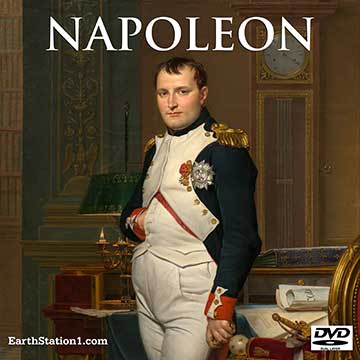
September 15, 1812: The Age Of
Enlightenment (The Enlightenment, The Age Of Reason): The Age Of
Revolution: The Atlantic Revolutions: The French Revolution: The
French Revolutionary And Napoleonic Wars (The Great French War)
(The French Revolutionary Wars, The Napoleonic Wars): The
Napoleonic Wars: The French Invasion Of Russia (The Russian
Campaign, The Patriotic War Of 1812): The Fire Of Moscow (1812):
-- The French Grande Armee under Napoleon reaches the Kremlin in a
burning Moscow. The Moscow Kremlin (Russian: Moskovskiy Kreml),
usually referred to as the Kremlin, is a fortified complex at the
heart of Moscow, overlooking the Moskva River to the south, Saint
Basil's Cathedral and Red Square to the east, and the Alexander
Garden to the west. It is the best known of the kremlins (Russian
citadels) and includes five palaces, four cathedrals, and the
enclosing Kremlin Wall with Kremlin towers. Also within this
complex is the Grand Kremlin Palace; that was formerly the tsar's
Moscow residence. The complex now serves as the official residence
of the President of the Russian Federation and as a museum with
2,746,405 visitors in 2017. The name "Kremlin" means
"fortress inside a city", and is often also used
metonymically to refer to the government of the Russian Federation
in a similar sense to how "White House" is used to refer
to the Executive Office of the President of the United States. It
had previously been used to refer to the government of the Soviet
Union (1922-1991) and its highest members (such as general
secretaries, premiers, presidents, ministers, and commissars). The
term "Kremlinology" refers to the study of Soviet and
Russian politics. The 1812 Fire Of Moscow (sometimes referred to
as The Kreme Brulee) begins as soon as Russian troops and most
remaining residents abandoned the city as Napoleon' vanguard
troops entered the city following the Battle Of Borodino, the
bloodiest battle of the Napoleonic Wars. The fire destroyed almost
the entire city of Moscow. The majority of Moscow residents left
the city during August 1812. On Sale Until Midnight Tonight PT!
https://store.earthstation1.com/napoleon-bonaparte-documentaries-collection-mp4-video-download-dv4.html
Today's
EarthStation1.com 15% (Or More!) Off Commemorative Memorial Title:
The American Diary: US History 1895-1933 TV Series DVD MP4 USB
Drive
Today, September 15, 2026
September 15, 1857: #BOTD: #HBD! William
Howard Taft, 27th President of the United States (1909-1913) and
the tenth Chief Justice of the United States (1921-1930), the only
person to have held both offices (d. March 8, 1930) is #born in
Cincinnati, Ohio into the politically distinguished extended Taft
family; though his parents were not wealthy, living in a modest
home in the suburb of Mount Auburn, his father Alphonso served as
a judge and an ambassador, and was U.S. Secretary of War and
Attorney General under President Ulysses S. Grant. William Taft
was not seen as brilliant as a child, but was a hard worker; his
demanding parents pushed him and his four brothers toward success,
tolerating nothing less. Taft was elected president in 1908, the
chosen successor of Theodore Roosevelt, but was defeated for
re-election by Woodrow Wilson in 1912 after Roosevelt split the
Republican vote by running as a third-party candidate. In 1921,
President Warren G. Harding appointed Taft to be chief justice, a
position in which he served until a month before his death. Taft
was born in Cincinnati in 1857. His father, Alphonso Taft, was a
U.S. Attorney General and Secretary of War. Taft attended Yale
and, like his father, was a member of Skull and Bones. After
becoming a lawyer, he was appointed a judge while still in his
twenties. He continued a rapid rise, being named Solicitor General
and as a judge of the Sixth Circuit Court of Appeals. In 1901,
President William McKinley appointed Taft civilian governor of the
Philippines. In 1904, Roosevelt made him Secretary of War, and he
became Roosevelt's hand-picked successor. Despite his personal
ambition to become chief justice, Taft declined repeated offers of
appointment to the Supreme Court Of The United States, believing
his political work to be more important. With Roosevelt's help,
Taft had little opposition for the Republican nomination for
president in 1908 and easily defeated William Jennings Bryan for
the presidency that November. In the White House, he focused on
East Asia more than European affairs and repeatedly intervened to
prop up or remove Latin American governments. Taft sought
reductions to trade tariffs, then a major source of governmental
income, but the resulting bill was heavily influenced by special
interests. His administration was filled with conflict between the
conservative wing of the Republican Party, with which Taft often
sympathized, and the progressive wing, toward which Roosevelt
moved more and more. Controversies over conservation and antitrust
cases filed by the Taft administration served to further separate
the two men. Roosevelt challenged Taft for renomination in 1912.
Taft used his control of the party machinery to gain a bare
majority of delegates and Roosevelt bolted the party. The split
left Taft with little chance of re-election and he took only Utah
and Vermont in Wilson's victory. After leaving office, Taft
returned to Yale as a professor, continuing his political activity
and working against war through the League to Enforce Peace. In
1921, President Harding appointed Taft as chief justice, an office
he had long sought. Chief Justice Taft was a conservative on
business issues and under him there were advances in individual
rights. In poor health, he resigned in February 1930. He died the
following month at his Washington, D.C. home aged 72, likely of
heart disease, inflammation of the liver, and high blood pressure.
Taft lay in state at the United States Capitol rotunda.[226] On
March 11, he became the first president and first member of the
Supreme Court to be buried at Arlington National Cemetery. James
Earle Fraser sculpted his grave marker out of Stony Creek granite,
a distinguished pink/orange granite still quarried at Stony Creek,
a coastal village in Branford, Connecticut centered on a harbor on
Long Island Sound, that was also used for the Brooklyn Bridge, the
Stony Creek Library, the newest House Office Building in
Washington, D.C, the South Station terminal in Boston, Grand
Central Terminal in NYC, and the base of the Statue of Liberty.
Taft is generally listed near the middle in historians' rankings
of U.S. presidents. On Sale Until Midnight Tonight PT!
https://store.earthstation1.com/american-diary-complete-us-historytv-series-2-dual-layer-dvd2.html
Today's
EarthStation1.com 15% (Or More!) Off Commemorative Memorial Title:
POW: Americans In Enemy Hands Documentary DVD, Download, USB Drive
Today, September 15, 2026
September 15, 1918: #BOTD: #HBD! Phil
Lamason, distinguished New Zealand soldier and pilot (d. May 19,
2012) is #born. Squadron Leader Phillip John Lamason DFC &
Bar, nicknamed Phil, was a pilot in the Royal New Zealand Air
Force (RNZAF) during the Second World War, who rose to prominence
as the senior officer in charge of 168 Allied airmen taken to
Buchenwald concentration camp, Germany, in August 1944. Raised in
Napier, he joined the RNZAF in September 1940, and by April 1942
was a pilot officer serving with the Royal Air Force in Europe. On
8 June 1944, Lamason was in command of a Lancaster heavy bomber
that was shot down during a raid on railway marshalling yards near
Paris. Bailing out, he was picked up by members of the French
Resistance and hidden at various locations for seven weeks. While
attempting to reach Spain along the Comet line, Lamason was
double-crossed by a traitor within the Resistance and handed over
to the Gestapo. After interrogation, he was taken to Fresnes
prison. Classified as a "Terrorflieger" (terror flier),
he was not accorded prisoner-of-war (POW) status, but instead
treated as a criminal and spy. By August 15, 1944 Lamason was
senior officer of a group of 168 captured Allied airmen who were
taken by train to Buchenwald concentration camp, arriving there
five days later. At Buchenwald, the airmen were fully shaved,
starved, denied shoes, and for three weeks forced to sleep outside
without shelter in one of the sub-camps known as "Little
Camp". As senior officer, Lamason took control and instilled
a level of military discipline and bearing. For several weeks
Lamason negotiated with the camp authorities to have the airmen
transferred to a POW camp, but his requests were denied. At great
risk, Lamason secretly got word to the Luftwaffe of the Allied
airmen's captivity and, seven days before their scheduled
execution, 156 of the 168 prisoners were transferred to Stalag
Luft III. Most of the airmen credit their survival at Buchenwald
to the leadership and determination of Lamason. After the war, he
moved to Dannevirke and became a farmer until his retirement.
During the 1980s and 1990s, he was a regular speaker at KLB Club
and POW reunions. Lamason died at his home on the farm outside
Dannevirke where he had lived for over 60 years. He was 93 and at
the time of his death, survived by two sons and two daughters. He
was predeceased by his wife, Joan (nee Hopkins), who died in 2007.
He is buried with her at Mangatera Cemetery in Dannevirke,
Manawatu-Whanganui, New Zealand. On Sale Until Midnight Tonight
PT!
https://store.earthstation1.com/pow-americans-in-enemy-hands--wwii-korea-vietnam-dvd.html
Today's
EarthStation1.com 15% (Or More!) Off Commemorative Memorial Title:
Going Hollywood: The War Years U.S. WWII Cinema DVD Download USB
Drive
Today, September 15, 2026
September 15, 1922: #BOTD: #HBD! Jackie
Cooper, American actor, sailor, television director, producer,
executive and race car driver (d. May 3, 2011) is #born John
Cooper Jr. in Los Angeles, California to an Italian-American
pianist mother and a Jewish father who left the family when Jackie
Cooper was two years old. He was a child actor who successfully
made the transition to an adult career. Cooper was the first child
actor to receive an Oscar nomination. At age 9 he became the
youngest performer to be nominated for an Academy Award for Best
Actor, an honor that he received for the film Skippy (1931). For
nearly 50 years, Cooper remained the youngest Oscar nominee in any
category. Cooper first appeared in films as an extra with his
grandmother, who took him to her auditions hoping it would help
her get extra work. At age 3 Jackie appeared in Lloyd Hamilton
comedies under the name of "Leonard". Cooper graduated
to bit parts in feature films such as Fox Movietone Follies of
1929 and Sunny Side Up. His director in those films, David Butler,
recommended Cooper to director Leo McCarey, who arranged an
audition for the Our Gang comedy series produced by Hal Roach. In
1929, Cooper signed a three-year contract after joining the series
in the short Boxing Gloves. He initially was to be a supporting
character in the series, but by early 1930 his success in
transitioning to sound films enabled him to become one of Our
Gang's major characters. He was the main character in the episodes
The First Seven Years and When the Wind Blows. His most notable
Our Gang shorts explore his crush on Miss Crabtree, the
schoolteacher played by June Marlowe. His Our Gang shorts included
Teacher's Pet, School's Out, and Love Business. While under
contract to Hal Roach Studios, in 1931 Cooper was loaned to
Paramount to star in Skippy, directed by his uncle, Norman Taurog.
At age 9, Cooper was nominated for an Academy Award for Best
Actor, the youngest actor to be nominated for an Oscar in that
category. Although Paramount paid Roach 25K USD for Cooper's
services, Roach paid Cooper a standard salary of 50 USD per week.
Our Gang producer Hal Roach sold Jackie's contract to
Metro-Goldwyn-Mayer in 1931. Cooper acted with Wallace Beery in
The Champ (1931-Beery's Oscar-winning role); a wittily comedic
romp titled The Bowery (1933) with George Raft, Fay Wray and Pert
Kelton; Robert Louis Stevenson's Treasure Island (1934) with
Lionel Barrymore, Lewis Stone and Nigel Bruce; and a father-son
circus story about a one-armed animal trainer titled
O'Shaughnessy's Boy (1935). In his autobiography, Cooper wrote
that Beery was a disappointment and accused Beery of upstaging him
and attempting to undermine his performances out of jealousy. He
starred in two television sitcoms, NBC's The People's Choice with
Patricia Breslin and CBS's Hennesey with Abby Dalton. In 1954, he
guest-starred on the NBC legal drama Justice. He appeared on ABC's
The Pat Boone Chevy Showroom, guest-starred with Tennessee Ernie
Ford on NBC's The Ford Show as America's Uranium King, and as
Charles A. Steen in "I Found 60 Million Dollars" on the
Armstrong Circle Theatre. In 1950, Cooper was cast in a production
of Mr. Roberts in Boston, Massachusetts in the role of Ensign
Pulver. From 1964 to 1969, Cooper was vice president of program
development at Columbia Pictures Screen Gems TV division. He was
responsible for packaging series such as Bewitched and selling
them to the networks. In 1964, Cooper appeared in Rod Serling's
The Twilight Zone episode "Caesar and Me", and in 1968 a
made-for-television film Shadow on the Land. Cooper left Columbia
in 1969. He appeared in the fourth season of Hawaii Five-O in an
episode called The Burning Ice. Cooper appeared in Candidate for
Crime starring Peter Falk as Columbo in 1973, and in the 1975 ABC
series Mobile One, a Jack Webb/Mark VII Limited production. He
guest-starred in a 1978 two-part episode of The Rockford Files:
The House on Willis Avenue. Cooper's work as director on episodes
of M*A*S*H and The White Shadow earned him Emmy awards. In the
1970s and 1980s, Cooper appeared as Daily Planet editor Perry
White in the Superman film series, a role he got after Keenan
Wynn, who was originally cast as White, became unavailable after
suffering a heart attack. Cooper's final film role was as Ace
Morgan in the 1987 film Surrender, starring Sally Field, Michael
Caine, and Steve Guttenberg. Cooper served in the United States
Navy during World War II and remained active in the Naval Reserve
until 1982, retiring at the rank of captain and receiving the
Legion of Merit. He was married to June Horne from 1944 until
1949, with whom he had a son, John "Jack" Cooper, III,
who was born in 1946. June was the daughter of director James W.
Horne and actress Cleo Ridgely. Cooper was married to Hildy Parks
from 1950 until 1951, and to Barbara Rae Kraus from 1954 until her
death in 2009. Cooper and Kraus had three children, Russell, born
in 1956, Julie, born in 1957, and Cristina, born in 1959. Julie
and Cristina died in 1997 and 2009, respectively. Cooper
participated in several automobile racing events, including the
record-breaking class D cars at the Bonneville Salt Flats in Utah.
He drove in several SCCA road racing competitions. Cooper was
named the honorary starter for the 1976 Winston 500 at the Alabama
International Motor Speedway, which is now known as Talladega
Superspeedway, in Talladega, Alabama. Cooper's autobiography,
Please Don't Shoot My Dog, was published in 1982. The title refers
to an incident during the filming of Skippy, when Norman Taurog,
who was directing Cooper in a crying scene, ordered a security
guard to take away his dog and pretend to shoot him backstage. The
stunt resulted in genuine tears; however, even upon discovering
his dog was fine, Cooper was left with ill feelings toward his
uncle. Cooper announced his retirement in 1989, although he
continued directing episodes of the syndicated series Superboy. He
began spending more time training and racing horses at Hollywood
Park and outside San Diego during the Del Mar racing season.
Cooper lived in Beverly Hills from 1955 until his death. For his
contributions to the motion picture industry, Cooper was honored
with a Hollywood Walk of Fame star located at 1507 Vine Street.
Cooper died on May 3, 2011 of natural causes, in Santa Monica,
California. He was survived by his two sons. He outlived both his
daughters and wife, Barbara Rae Kraus. He was interred at
Arlington National Cemetery in Arlington, Virginia, in honor of
his naval service. On Sale Until Midnight Tonight PT!
https://store.earthstation1.com/going-hollywood-the-war-years-us-wwii-cinema-dvd-download-usb-drive.html
Today's
EarthStation1.com 15% (Or More!) Off Commemorative Memorial Title:
Jean Shepherd Radio Shows All Known To Exist DVD, MP3 Download,
USB
Today, September 15, 2026
September 15, 1881: #BOTD: #HBD! Ettore
Bugatti, Italian born French engineer, automobile designer and
manufacturer, and businessman, founder of Bugatti Automobiles
(Automobiles Ettore Bugatti) (d. August 21, 1947) is #born Ettore
Arco Isidoro Bugatti into an artistic family in Milan, Italy. He
is remembered as the founder and proprietor of the high
performance, artisticallly designed automobile manufacturing
company Automobiles E. Bugatti, which he founded in 1909 in the
then German town of Molsheim in the Alsace region of what is now
France. Ettore Bugatti died at the American hospital in the
inner-Paris suburb of Neuilly, France, aged 65. Afflicted by a
paralysis of his mental faculties, he died while unconcious.
Bugatti was buried in the Bugatti family plot at the municipal
cemetery in Dorlisheim near Molsheim in the Bas-Rhin departement
of France. Molsheim's Musee de la Chartreuse houses a section
dedicated to his life, work, and legacy. On Sale Until Midnight
Tonight PT!
https://store.earthstation1.com/complete-jean-shepherd-radio-and-lp-collection-mp3-dvds-2-dis32.html
Today's
EarthStation1.com 15% (Or More!) Off Commemorative Memorial Title:
The Ten Year Lunch: Wit And Legend Of The Algonquin MP4 Download
DVD
Today, September 15, 2026
September 15, 1889: #BOTD: #HBD! Robert
Benchley, American humorist, newspaper columnist, and actor (d.
November 21, 1945) is #born Robert Charles Benchley in Worcester,
Massachusetts. Benchley's style of humor brought him respect and
success during his life, from his beginnings at The Harvard
Lampoon while attending Harvard University, through his many years
writing essays and articles for Vanity Fair and The New Yorke, and
his acclaimed short films, from his peers at the Algonquin Round
Table in New York City to contemporaries in the burgeoning film
industry. Benchley is best remembered for his contributions to The
New Yorker, where his essays, whether topical or absurdist,
influenced many modern humorists. He also made a name for himself
in Hollywood, when his short film How to Sleep was a popular
success and won Best Short Subject at the 1935 Academy Awards. He
also made many memorable appearances acting in films such as
Alfred Hitchcock's Foreign Correspondent (1940) and Nice Girl?
(1941). His legacy includes written work and numerous short film
appearances. Robert Benchley died of cirrhosis of the liver in a
New York hospital, aged 56. He is buried at Prospect Hill Cemetery
in Nantucket, Massachusetts. #RobertBenchley #Humorists
#NewspaperColumnists #Actors #TheHarvardLampoon #VanityFair
#TheNewYorker #ShortFilms #HowToSleep #AlgonquinRoundTable
#AlgonquinClub #AlgonquinHotel #MP3 #AudioDownload #DVD On Sale
Until Midnight Tonight PT!
https://store.earthstation1.com/the-ten-year-lunch-wit-and-legend-of-algonquin-round-table-dvd.html
Today's
EarthStation1.com 15% (Or More!) Off Commemorative Memorial Title:
The Golden Age Of Comedy 5 Album Set CD, MP3, USB Stick
Today, September 15, 2026
September 15, 1927: #BOTD: #HBD! Norm
Crosby, American comedian, actor and Freemason associated with the
Borscht Belt who often appeared on television in the 1970s (d.
November 7, 2020) is #born Norman Lawrence Crosby in Boston,
Massachusetts to a Jewish family. He as "The Master Of
Malaprop" for his use of malapropisms, he went solo as a
standup comedian, adopting a friendly, blue collar, guy-next-door
persona in the 1950s. Crosby refined his standup monologues by
interpolating malapropisms. He first appeared on The Tonight Show
Starring Johnny Carson in December 1964. In the fall of 1968, he
co-starred on The Beautiful Phyllis Diller Show, an NBC twelve
week series. In 1974, he co-hosted a Canadian variety television
series, Everything Goes. From 1974-84 he was on over half a dozen
Dean Martin Celebrity Roasts including George Burns and two
separate roasts of Redd Foxx. From 1978-81, he hosted a nationally
syndicated series, The Comedy Shop, in which a mix of
up-and-coming stand-up comics and vaudeville legends presented
their material. In the late 1970s and early 1980s, Crosby became a
commercial pitchman for Anheuser-Busch Natural Light beer. During
this time, he also appeared as a celebrity guest on a number of
game shows, including Celebrity Bowling, Liar's Club, Tattletales
and Hollywood Squares. From 1983 until the program's
disassociation with Jerry Lewis, Crosby co-hosted and contributed
to the annual Jerry Lewis MDA Labor Day Telethon. He has a star on
the Hollywood Walk of Fame at 6560 Hollywood Boulevard. Crosby has
been married to Joan Crane Foley since 1966. They have two
children. He has been a Freemason since 1956, having served as
Master of at least one lodge and participated in many charitable
activities. As of September 2005, he was a member of Ionic
Composite Lodge #520 in Los Angeles, California. Norm Crosby died
of heart failure at his home in Los Angeles, California, at the
age of 93. He is buried at Hillside Memorial Park in Culver City,
Los Angeles County, California. On Sale Until Midnight Tonight PT!
https://store.earthstation1.com/golden-age-of-comedy-narrated-by-george-burns-5-album-set-mp3-53.html
Today's
EarthStation1.com 15% (Or More!) Off Commemorative Memorial Title:
Rhythm And Blues Revue (1955) DVD, MP4 Video Download, USB Flash
Drive
Today, September 15, 2026
September 15, 1918: #BOTD: #HBD! Nipsey
Russell, African American soldier, medic, comedian, actor, poet
and dancer (d. October 2, 2005) is #born Julius Russell in
Atlanta, Georgia. Russell is best known for his appearances as a
panelist on game shows from the 1960s through the 1990s, including
Match Game, Password, Hollywood Squares, To Tell the Truth, and
Pyramid. His appearances were often distinguished by short,
humorous poems he recited during the broadcast, which led to his
nickname "the poet laureate of television". He had one
of the leading roles in the film version of The Wiz as the Tin
Man. He was a frequent guest on the Dean Martin Celebrity Roast
series. He went to Booker T. Washington High School in Atlanta and
attended the University of Cincinnati for one semester in 1936. He
served as a medic in the United States Army during World War II,
enlisting as a private on June 27, 1941, and returning from Europe
in 1945 as a second lieutenant. He got his start as a comedian in
the 1940s as a carhop at the Atlanta drive-in The Varsity, where
he increased the tips he earned by making customers laugh. He was
discovered after he began performing in nightclubs in the 1950s.
He subsequently made many "party albums", which were
essentially compilations of his stand-up routines. In 1952,
Russell joined with film comedian Mantan Moreland for a stage act,
replacing Ben Carter as Moreland's dapper straight man. One of
their bits was an old routine that Moreland and Carter had
performed in vaudeville and in Charlie Chan films. In the
"interruption routine" (or "incomplete sentences")
Moreland would engage Russell in conversation, only to be
interrupted by Russell, who in turn was interrupted by Moreland.
Soon the entire conversation was conducted in incomplete
sentences, with each man anticipating or contradicting the other.
Their act can be seen in two all-black-cast compilation films,
Rhythm and Blues Review and Rock and Roll Revue; another variation
of the "interruption routine", performed by Tommy
Davidson and Savion Glover, was featured in Spike Lee's 2000 film
Bamboozled. A September 1957 appearance on The Ed Sullivan Show
led to several guest spots with Jack Paar on The Tonight Show, and
in 1961 a supporting role as a New York policeman, "Andy"
Anderson, in the sitcom Car 54, Where Are You? Russell returned to
the role in the feature-film version of Car 54, Where Are You?
(filmed in 1990, released in 1994), with "Anderson" now
serving as the precinct captain. In 1965 Russell became a co-host
of ABC's Les Crane Show. In 1970 he was a co-star on the ABC
sitcom Barefoot in the Park. From 1973 through 1976 he appeared
regularly on The Dean Martin Show and The Dean Martin Comedy
World. Scattered appearances on television series followed, as
well as occasional guest-host stints on The Tonight Show during
the Johnny Carson era. Russell also appeared frequently in Las
Vegas, including a series of appearances with Sergio Franchi at
the Frontier Hotel in 1978 and 1979,[9] and with Franchi in 1979
at the Sands Hotel Copa Room. He performed at Kutsher's Country
Club in Monticello, NY on January 1, 1977. Russell became the
first black performer to become a regular panelist on a daily
network game show when he joined ABC's Missing Links in 1964.
Another ABC show, Rhyme and Reason, had poetry as a premise. In
1971 he started as a featured panelist on To Tell the Truth, which
led to his being hired for The Match Game when Goodson-Todman
Productions revived it two years later. He also served as panelist
in 1968 on the syndicated version of What's My Line? Producer Bob
Stewart featured him regularly as a panelist on Pyramid throughout
its 1970s and 1980s runs. Russell would host two game show pilots:
one was Star Words for Mark Goodson in 1983 and a revival of
Jackpot for Bob Stewart in 1984. These pilots were shot for CBS,
but neither pilot was picked up by the network. Russell went on to
host two revivals of Jack Barry and Dan Enright's Juvenile Jury
for BET from 1983 to 1984, then again for syndication from 1989 to
1991. In 1985 he hosted the short-lived 1985 NBC game show Your
Number's Up, which was produced by Sande Stewart. During his
appearances on game shows, at some point in the broadcast the host
would give the floor to Russell, who would recite a self-penned
poem from memory, looking straight into the camera He was a
trained dancer, influenced in his youth by Jack Wiggins. Russell
put these talents to use in the 1978 musical The Wiz as the Tin
Man. He also appeared on the big screen in 1994's adaptation of
Car 54, Where Are You?, reprising his role as Anderson, now
promoted from sergeant to captain. During the 1990s Russell gained
popularity with a new generation of television viewers as a
regular on Late Night with Conan O'Brien. Russell often appeared
during comedy sketches between scheduled guests and delivered his
trademark rhymes. Russell's final TV appearance was as a panelist
on a game show-themed week on the final season of the Tom Bergeron
version of Hollywood Squares in 2003. Russell died in 2005 at age
87 in New York City, after suffering from cancer. He was cremated
and his ashes scattered in the Atlantic Ocean. On Sale Until
Midnight Tonight PT!
https://store.earthstation1.com/rhythm-and-blues-revue-dvd-1955-apollo-theater-tv-1955.html
Today's
EarthStation1.com 15% (Or More!) Off Commemorative Memorial Title:
WABC Radio Airchecks MP3 Collection 1960s-1980s DVD, MP3 Download,
USB
Today, September 15, 2026
September 15, 1928: #BOTD: #HBD! Jack
Spector, American radio disc jockey, particularly known for his
work in New York City during the 1960s "rock radio" era
(d. March 8, 1994) is #born in Brooklyn, New York, where he was
raised. Spector began his career in 1955 and in 1961 became one of
the original WMCA Good Guys. In late December 1963, WMCA, with
Spector, earned the distinction of being the first New York City
radio station to play the Beatles' Capitol Records' single, "I
Want to Hold Your Hand" (Outside New York, the single's
broadcast debut is widely accepted to have occurred earlier at
WWDC in Washington, D.C.). WMCA was keen on playing new product
and breaking new hits, and consequently, Spector became associated
with the radio station most credited with introducing Beatlemania
- and the "British Invasion" musical movement - to New
York City listeners. In 1962, The Four Seasons released their
first number one hit on the Billboard Hot 100 "Sherry".
While there were many suggestions for the name of the song, it was
called "Sherry" after Spector's eldest daughter. The
song reached #1 on September 15th, 1962, which was Spector's 34th
birthday. In 1969, while continuing to work as a DJ in New York,
Spector released a single on Buddah Records under the name, "Vik
Venus, Alias: Your Main Moon Man". The single, "Moonflight",
was a novelty "break-in" record in the style of Dickie
Goodman. In it, a reporter asks the astronauts questions about a
fictional "Achilles moon flight", with the responses
taken from snippets of popular songs of the day. All response
fragments used for this record were from previous hits on Buddah.
The record peaked at #38 on the U.S. Billboard Hot 100 chart, and
#20 in Canada. WMCA moved to a talk format September 21, 1970, one
day after the final top-40 broadcast. Spector stayed on as host of
a sports talk show. In about 1971 Spector moved to WHN, then a
vocal-based easy listening station. He remained for a while after
WHN became a country music station in 1973. In 1974, Spector left
WHN to go to WCBS-FM where he hosted a 1955-1964 based Oldies show
called "The Saturday Night Sock Hop" and another regular
weekend shift. He was also a full-time swing host there, filling
in for various airstaffers over the years. In 1983, Cousin Brucie
began doing every third Saturday night of the month. Spector
remained at WCBS-FM until the Spring of 1985. In 1985, Spector was
at WNBC as the original host of "Sports Night",
eventually replaced by Dave Sims. He went then to WPIX-FM, which
was playing an adult contemporary format. Upon their change to NAC
and soon after to smooth jazz, he became one of the first on air
personalities on CD 101.9. Spector also owned a retail optical
store when he was not on the air (after his death, Howard Stern,
who worked for WNBC, said Jack was one of the few fellow disc
jockeys he liked, and who liked him). Late in 1988, Spector left
WQCD and joined the staff of WHLI at Hempstead, New York playing
an Adult Standards format. That station began mixing in more rock
and roll oldies by the early '90s. After a few Radio Greats
Weekends at WCBS-FM, Jack Spector returned as a part-time swing
announcer there in 1993 while working full-time at WHLI. On March
8, 1994, shortly after starting a recording of Louis Prima's "I'm
In The Mood For Love", he suffered an apparent heart attack
and collapsed to the floor. Following a long silence after the
song had finished, radio station employees ran into the studio and
found Spector on the floor. Attempts to revive him failed and he
was pronounced dead at Winthrop University Hospital. He was 65. He
is buried at Beth Moses Cemetery in Farmingdale, New York. On Sale
Until Midnight Tonight PT!
https://store.earthstation1.com/wabc-musicradio-shows-mp3-dvd-60s80s-am-360807775.html
Today's
EarthStation1.com 15% (Or More!) Off Commemorative Memorial Title:
Jessye Norman: The 1992 Interview DVD, MP4 Download, USB Drive
Today, September 15, 2026
September 15, 1945: #BOTD: #HBD! Jessye
Norman, African American opera singer and recitalist (d. September
30, 2019) is #born in Augusta, Georgia. She was able to perform
dramatic soprano roles, but refused to be limited to that voice
type. She was a commanding presence on operatic, concert and
recital stages, associated with roles including Beethoven's
Leonore, Wagner's Sieglinde and Kundry, Cassandre and Didon by
Berlioz and Bartok's Judith. The New York Times music critic
Edward Rothstein described her voice as a "grand mansion of
sound", and wrote that "it has enormous dimensions,
reaching backward and upward. It opens onto unexpected vistas. It
contains sunlit rooms, narrow passageways, cavernous halls."
Norman was trained at Howard University, the Peabody Institute,
and the University of Michigan. Her career began in Europe, where
she won the ARD International Music Competition in Munich in 1968,
which led to a contract with the Deutsche Oper Berlin. Her
operatic debut came as Elisabeth in Wagner's Tannhauser, after
which she sang as Verdi's Aida at La Scala in Milan. She made her
first operatic appearance in the U.S. in 1982 with the Opera
Company of Philadelphia, when cast as Jocasta in Stravinsky's
Oedipus rex, and as Dido in Purcell's Dido and Aeneas. She went on
to sing leading roles with many other companies, including the
Metropolitan Opera, the Lyric Opera of Chicago, the Paris Opera,
and the Royal Opera, London. She sang at the second inauguration
of Ronald Reagan, at Queen Elizabeth II's 60th birthday
celebration in 1986, and performed the La Marseillaise to
celebrate the 200th anniversary of the French Revolution on July
14, 1989. She sang at the 1996 Summer Olympics opening ceremony in
Atlanta and for the second inauguration of Bill Clinton in 1997.
Norman sang and recorded recitals of music by Franz Schubert,
Johannes Brahms, Richard Strauss, Gustav Mahler, Ernest Chausson
and Francis Poulenc, among others. In 1984, she won the Grammy
Award for Best Classical Vocal Solo, the first of five Grammy
Awards that she would collect during her career. Apart from
several honorary doctorates and other awards, she received the
Grammy Lifetime Achievement Award and the National Medal of Arts,
and was a member of the British Royal Academy of Music. In 1990,
UN Secretary-General Javier Perez de Cuellar named her Honorary
Ambassador to the United Nations. Jessye Norman died in New York
City at the age of 74 of septic shock and multi-organ failure
secondary to complications of a 2015 spinal-cord injury. Norman's
public funeral was held in her hometown of Augusta, Georgia. Actor
Laurence Fishburne, sociologist Michael Eric Dyson, Carnegie
Hall's Clive Gillinson, civil rights activist Vernon Jordan, and
Mayor Hardie Davis spoke. Opera's J'Nai Bridges, jazz's Wycliffe
Gordon, and students from Morehouse College and Spelman College,
as well as Jessye Norman School of the Arts, performed. Norman was
memorialized with a gala tribute at the Metropolitan Opera House,
New York City, on November 24, 2019. Among the speakers and
performers at the public remembrance were Anna Deavere Smith;
Gloria Steinem; the former Minister of Culture of France, Jack
Lang; Eric Owens; The Dance Theatre of Harlem; the Alvin Ailey
American Dance Theater; Peter Gelb; and Renee Fleming. She is
buried at Westover Memorial Park cemetery in Augusta, Georgia. On
Sale Until Midnight Tonight PT!
https://store.earthstation1.com/jessye-norman-the-1992-interview-dvd-mp4-usb-19924.html
Today's
EarthStation1.com 15% (Or More!) Off Commemorative Memorial Title:
TV Commercials: The Cable Age Classics II DVD, Download, USB Drive
Today, September 15, 2026
September 15, 1890: #BOTD: #HBD! Agatha
Christie, English crime novelist, short story writer, and
playwright known for her 66 detective novels and 14 short story
collections, particularly those revolving around fictional
detectives Hercule Poirot and Miss Marple (d. January 12, 1976) is
#born Agatha Mary Clarissa Miller into a wealthy upper middle
class family in Torquay, Devon. Dame Agatha Mary Clarissa
Christie, Lady Mallowan, DBE also wrote the world's
longest-running play, The Mousetrap, which has been performed in
the West End since 1952, as well as six novels under the pseudonym
Mary Westmacott. In 1971, she was made a Dame (DBE) for her
contributions to literature. Guinness World Records lists Christie
as the best-selling fiction writer of all time, her novels having
sold more than two billion copies. Christie was largely
home-schooled. She was initially an unsuccessful writer with six
consecutive rejections, but this changed in 1920 when The
Mysterious Affair at Styles, featuring detective Hercule Poirot,
was published. Her first husband was Archibald Christie; they
married in 1914 and had one child before divorcing in 1928. During
both World Wars, she served in hospital dispensaries, acquiring a
thorough knowledge of the poisons that featured in many of her
novels, short stories, and plays. Following her marriage to
archaeologist Max Mallowan in 1930, she spent several months each
year on digs in the Middle East and used her first-hand knowledge
of this profession in her fiction. According to UNESCO's Index
Translationum, she remains the most-translated individual author.
Her novel And Then There Were None is one of the top-selling books
of all time, with approximately 100 million copies sold.
Christie's stage play The Mousetrap holds the world record for the
longest initial run. It opened at the Ambassadors Theatre in the
West End on 25 November 1952, and by September 2018 there had been
more than 27,500 performances. The play was temporarily closed in
March 2020 because of COVID-19 lockdowns in London before it
reopened in May 2021. In 1955, Christie was the first recipient of
the Mystery Writers of America's Grand Master Award. Later that
year, Witness for the Prosecution received an Edgar Award for best
play. In 2013, she was voted the best crime writer and The Murder
of Roger Ackroyd the best crime novel ever by 600 professional
novelists of the Crime Writers' Association. In September 2015,
And Then There Were None was named the "World's Favourite
Christie" in a vote sponsored by the author's estate. Many of
Christie's books and short stories have been adapted for
television, radio, video games, and graphic novels. More than 30
feature films are based on her work. Agatha Christie died
peacefully at age 85 from natural causes at her home at
Winterbrook House in Wallingford, Oxfordshire, England. Upon her
death, two West End theatres - the St. Martin's, where The
Mousetrap was playing, and the Savoy, which was home to a revival
of Murder At The Vicarage - dimmed their outside lights in her
honour. She is buried in the nearby churchyard of St Mary's,
Cholsey, Oxfordshire in a plot she had chosen with her husband 10
years previously. The simple funeral service was attended by about
20 newspaper and TV reporters, some having travelled from as far
away as South America. Thirty wreaths adorned Christie's grave,
including one from the cast of her long-running play The Mousetrap
and one sent "on behalf of the multitude of grateful readers"
by the Ulverscroft Large Print Book Publishers. Her husband Max
Mallowan, prominent British archaeologist and academic who
specialized in the Ancient Near East and who remarried in 1977,
died in 1978 and was buried next to Christie. On Sale Until
Midnight Tonight PT!
https://store.earthstation1.com/tv-commercials-the-cable-age-classics-ii-dvd.html
Today's
EarthStation1.com 15% (Or More!) Off Commemorative Memorial Title:
Lost TV Pilots 8 Mr. Ed, George Burns, Happy, More DVD, MP4, USB
Stick
Today, September 15, 2026
September 15, 1907: #BOTD: #HBD! Fay
Wray, Canadian-born American actress best remembered for starring
as Ann Darrow in the 1933 film King Kong (1933) (d. August 8,
2004) is #born Vina Fay Wray on a ranch near Cardston, Alberta
into a Mormon family. Through an acting career that spanned nearly
six decades, Fay Wray attained international recognition as an
actress in horror films. She has been dubbed one of the early
"scream queens". After appearing in minor film roles,
Wray gained media attention after being selected as one of the
"WAMPAS Baby Stars" in 1926. This led to her being
contracted to Paramount Pictures as a teenager, where she made
more than a dozen feature films. After leaving Paramount, she
signed deals with various film companies, being cast in her first
horror film roles, in addition to many other types of roles,
including in The Bowery (1933) and Viva Villa (1934), both of
which starred Wallace Beery. For RKO Radio Pictures, Inc., she
starred in the film for which she is most identified, King Kong
(1933). After the success of King Kong, Wray made numerous
appearances in both film and television; she retired in 1980. Fay
Wray died in her sleep of natural causes in the night in her
apartment on Fifth Avenue Manhattan, aged 96. She is interred at
the Hollywood Forever Cemetery in Hollywood, California. Two days
after her death, the lights of the Empire State Building were
lowered for 15 minutes in her memory. On Sale Until Midnight
Tonight PT!
https://store.earthstation1.com/lost-tv-pilots-8-mr-ed-george-burns-pride-of-the-family-happ8.html
Today's
EarthStation1.com #OnThisDay Commemorative Memorial Title: Long
Shadows: Civil War Legacy DVD, Video Download, USB Flash Drive
Today, September 15, 2026 September 15, 1989: #DOTD: #RIP Robert
Penn Warren, American novelist, poet, literary critic and Pulitzer
Prize recipient for both fiction and poetry (b. April 24, 1905)
#dies in Stratton, Vermont of complications from prostate cancer,
aged 84. He is buried at Stratton, Vermont, and, at his request, a
memorial marker is situated in the Warren family gravesite in
Guthrie, Kentucky. Robert Penn Warren was born in Guthrie,
Kentucky, very near the Tennessee-Kentucky border, an area
sometimes colloquially known as "Tennetucky". He was one
of the founders of New Criticism, a formalist movement in literary
theory that dominated American literary criticism in the middle
decades of the 20th century that emphasized close reading,
particularly of poetry, to discover how a work of literature
functioned as a self-contained, self-referential aesthetic object.
He was also a charter member of the Fellowship of Southern
Writers, a literary organization founded in 1987 in Chattanooga,
Tennessee by 21 Southern writers and other literary luminaries
that meets in every odd-numbered year, usually during the
Chattanooga Arts & Education Council Conference on Southern
Literature. He founded the literary journal The Southern Review
with Cleanth Brooks in 1935, a quarterly literary magazine that
Warren established at the behest of Charles W. Pipkin and funded
by Huey Long as a part of his investment in Louisiana State
University.. He received the 1947 Pulitzer Prize For The Novel
(now called the Pulitzer Prize For Fiction) for All the King's Men
(1946), a novel inspired by the life of Huey Long, and the
Pulitzer Prize for Poetry in both 1958 and 1979. He is the only
person to have won Pulitzer Prizes for both fiction and poetry.
https://store.earthstation1.com/long-shadows-dvd-legacy-of-the-american-civil-war.html
September 15, 1989: #DOTD: #RIP Robert
Penn Warren, American novelist, poet, literary critic and Pulitzer
Prize recipient for both fiction and poetry (b. April 24, 1905)
#dies in Stratton, Vermont of complications from prostate cancer,
aged 84. He is buried at Stratton, Vermont, and, at his request, a
memorial marker is situated in the Warren family gravesite in
Guthrie, Kentucky. Robert Penn Warren was born in Guthrie,
Kentucky, very near the Tennessee-Kentucky border, an area
sometimes colloquially known as "Tennetucky". He was one
of the founders of New Criticism, a formalist movement in literary
theory that dominated American literary criticism in the middle
decades of the 20th century that emphasized close reading,
particularly of poetry, to discover how a work of literature
functioned as a self-contained, self-referential aesthetic object.
He was also a charter member of the Fellowship of Southern
Writers, a literary organization founded in 1987 in Chattanooga,
Tennessee by 21 Southern writers and other literary luminaries
that meets in every odd-numbered year, usually during the
Chattanooga Arts & Education Council Conference on Southern
Literature. He founded the literary journal The Southern Review
with Cleanth Brooks in 1935, a quarterly literary magazine that
Warren established at the behest of Charles W. Pipkin and funded
by Huey Long as a part of his investment in Louisiana State
University.. He received the 1947 Pulitzer Prize For The Novel
(now called the Pulitzer Prize For Fiction) for All the King's Men
(1946), a novel inspired by the life of Huey Long, and the
Pulitzer Prize for Poetry in both 1958 and 1979. He is the only
person to have won Pulitzer Prizes for both fiction and poetry.
https://store.earthstation1.com/long-shadows-dvd-legacy-of-the-american-civil-war.html
Today's
EarthStation1.com #OnThisDay Commemorative Memorial Title: The
Siege Of Vicksburg American Civil War DVD MP4 Download USB Drive
Today, September 15, 2026September 15, 2020: #DOTD: #RIP: Ed
Bearss (rhymes with "parse"), author, historian of the
American Civil War, tour guide, and United States Marine Corps
veteran of the battles of Guadalcanal And New Britain in the
Asia-Pacific Theater of World War II (b. June 26, 1923) #dies
shortly after a heart attack at an assisted-living facility in
Richland, Mississippi, aged 97. He is buried at Bethel Cemetery,
Brandon, Mississippi. He was born Edwin Cole Bearss in Billings,
Montana. He was raised working on his grandfather's ranch near
Hardin, Montana, and attended a one-room school in Sarpy, Montana.
Bearss was accepted to St. John's Military Academy in Delafield,
Wisconsin in 1937, and graduated from Hardin High School in 1941.
Bearss enlisted in the United States Marine Corps in 1941. During
World War II, he served in the 3rd Marine Raider Battalion; he
fought in the Guadalcanal and New Britain campaigns with the 1st
Marine Division. In 1943, Bearss caught malaria in the South
Pacific, and was sent to New Zealand to recover. On January 2,
1944, with the 3rd Battalion, 7th Marines at the Battle of Cape
Gloucester, Bearss was hit by Imperial Japanese Army machine-gun
fire that broke both of his arms and injured his heel and
buttocks; after spending the next 26 months in hospital, he left
the Marines in March 1946 with the rank of corporal. Bearss earned
two college degrees courtesy of the G.I. Bill: his Bachelor of
Science in Foreign Service from Georgetown University in 1949, and
his Master of Arts from Indiana University in 1955, the latter
with a thesis on Patrick Cleburne. In February 2005, Bearss was
awarded an honorary degree from Lincoln College in Lincoln,
Illinois; Gettysburg College did the same in 2010. In 1955, Bearss
began working for the National Park Service (NPS) in Vicksburg,
Mississippi. He prepared historical studies for the Interior
Department agency and founded the Mississippi Civil War
Roundtable. For the NPS, he found the Civil War-era cannon Widow
Blakely (also Whistling Dick) which had been used in the Vicksburg
campaign, as well as the wreck of USS Cairo. He also found two
lost forts in Grand Gulf, Mississippi, and was party to the
establishment of Grand Gulf as a state military monument. Bearss
was the NPS' chief historian from 1981-1994, and "special
assistant to the director for military sites" until 1995; in
1991, he was made the NPS' chief historian of military sites.
Bearss retired from the NPS on September 30, 1995, though he
continued to lead tours of ACW battlefields for the Smithsonian
Institution, the National Geographic Society, the National Trust
for Historic Preservation, and Civil War Roundtables. The NPS
awarded him the unique title of National Park Service Historian
Emeritus. Frances and Roger G. Kennedy endowed the Bearss
Fellowship Award in honor of the former chief-historian; it
"supports NPS employees' graduate-level studies in American
History or American Studies and is administered in partnership
with the National Park Foundation." On July 30, 1958, Bearss
married author and teacher Margie Riddle of Mississippi (born 1925
or 1926), and the two had three children: Sara in 1960, Edwin Jr.
in 1962, and Mary in 1965. The Company of Military Historians made
Bearss a fellow of that group in 1964, and he received the
Nevins-Freeman Award in 1980 for his work on American Civil War
(ACW) history. Three years later, the Department of the Interior
awarded him the Distinguished Service Award, and it was followed
by a commendation from the United States Secretary of the Army in
1985. On 23 April 2015, US Representative Gerry Connolly (VA)
introduced bill H.R.2059 to award Bearss the Congressional Gold
Medal "in recognition of his contributions to preservation of
American Civil War history and continued efforts to bring our
nation's history alive for new generations through his
interpretive storytelling." In June 2018, the American
Battlefield Trust awarded Bearss its first Lifetime Achievement
Award "for his many decades dedicated to researching and
relating the nation's past to millions of people, as well as his
advocacy for battlefield preservation."
https://store.earthstation1.com/the-siege-of-vicksburg-american-civil-war-dvd-mp4-download-usb-driv4.html
Today's
EarthStation1.com #OnThisDay Commemorative Memorial Title:
Offshore Pirate Radio 1960s-1980s MP3s DVD, Audio Download, USB
Drive
Today, September 15, 2026September 15, 2019: #DOTD: #RIP: Ric
Ocasek, American singer, songwriter, guitarist, record producer
and painter, the lead vocalist, rhythm guitarist, songwriter and
frontman for the rock band The Cars (b. March 23, 1949) #dies aged
75, found dead by his estranged wife, Paulina Porizkova, which
they still shared following their separation in 2017, at his New
York City townhouse while recovering from surgery for lung cancer.
The Office of Chief Medical Examiner of the City of New York
(OCME) reported that Ocasek had died from natural causes. He
suffered from both hypertensive heart and coronary artery disease.
Ocasek is buried at Nine Partners Cemetery in Millbrook, New York.
Porizkova and Ocasek were still in the process of their divorce at
the time of his death, but he had disinherited her in a new will,
alleging that before his recent surgery she had abandoned him.
This required a probate court judge to rule on the veracity of the
abandonment claims before the remaining estate could be divided.
He also disinherited two of his six sons. In 2021, the dispute
between Ocasek's estate and Porizkova was settled; Porizkova said
she was granted a third of his estate. While Porizkova would not
tell Vanity Fair the precise terms of the settlement, she denied
reports that Ocasek was "only worth 5M USD" at the time
of his death. Ric Ocasek was born Richard Theodore Otcasek in
Baltimore, Maryland. In addition to his work with the Cars, Ocasek
recorded seven solo albums, and his song "Emotion in Motion"
was a top 20 hit in the United States in 1986. Ocasek also worked
as a record producer for artists such as Suicide, Bad Brains,
Weezer, Nada Surf, Guided by Voices, and No Doubt. In 2018, Ocasek
was inducted into The Rock And Roll Hall Of Fame as a member of
the Cars. #RicOcasek #Singers #Songwriters #Guitarists
#RecordProducers #Painters #Artists #TheCars #RockMusic #NewWave
#PowerPop #MP3 #AudioDownload #MP3DVD
https://store.earthstation1.com/offshore-pirate-radio-2-dual-layer-mp3-dvds-uk-amp-euro23.html
Today's
EarthStation1.com #OnThisDay Commemorative Memorial Title: War
Jets: The North American F-86 Sabre Jet DVD, Download, USB Drive
Today, September 15, 2026September 15, 1948: Aviation: The History
Of Aviation: Flight Airspeed Records: -- The F-86 Sabre sets the
world aircraft speed record at 671 miles per hour (1,080 km/h),
near to the speech of sound, or Mach 1, at Muroc Dry Lake flown by
Major Richard L. Johnson, USAF; nevertheless, the first manned
supersonic flight occurred a year prior in secret on October 14,
1947, less than a month after the U.S. Air Force had been created
as a separate service. Captain Charles "Chuck" Yeager
piloted USAF aircraft #46-062, nicknamed Glamorous Glennis for his
wife. The airplane was drop launched from the bomb bay of a B-29
and reached Mach 1.06 (700 miles per hour (1,100 km/h; 610 kn)).
The North American F-86 Sabre, sometimes called the Sabrejet, is a
transonic jet fighter aircraft. Produced by North American
Aviation, the Sabre is best known as the United States' first
swept wing fighter that could counter the swept-wing Soviet MiG-15
in high-speed dogfights in the skies of the Korean War
(1950-1953), fighting some of the earliest jet-to-jet battles in
history. Considered one of the best and most important fighter
aircraft in that war, the F-86 is also rated highly in comparison
with fighters of other eras. Although it was developed in the late
1940s and was outdated by the end of the 1950s, the Sabre proved
versatile and adaptable and continued as a front-line fighter in
numerous air forces until the last active operational examples
were retired by the Bolivian Air Force in 1994. Its success led to
an extended production run of more than 7,800 aircraft between
1949 and 1956, in the United States, Japan, and Italy. Variants
were built in Canada and Australia. The Canadair Sabre added
another 1,815 airframes, and the significantly redesigned CAC
Sabre (sometimes known as the Avon Sabre or CAC CA-27), had a
production run of 112. The Sabre is by far the most-produced
Western jet fighter, with total production of all variants at
9,860 units.
https://store.earthstation1.com/war-jets-the-north-american-f86-sabre-jet-d86.html
Today's
EarthStation1.com #OnThisDay Commemorative Memorial Title: Wings
Over The World: Aviation History Series DVD, Download, USB Drive
Today, September 15, 2026September 15, 1978: #DOTD: #RIP: Willy
Messerschmitt, German engineer, aircraft designer, manufacturer
and businessman (b. June 26, 1898) #dies in a Munich hospital in
undisclosed circumstances, aged 80. He is buried at the
Hauptfriedhof Bamberg in Bamberg, Bavaria, Germany. Willy
Messerschmitt was born Wilhelm Emil Messerschmitt in Frankfurt am
Main, German Empire, the son of Baptist Ferdinand Messerschmitt
(1858-1916) and his second wife, Anna Maria Schaller (1867-1942).
Willy Messerschmitt's single most important design was the
Messerschmitt Bf 109, designed in 1934 with the collaboration of
Walter Rethel. The Bf 109 became the most important fighter in the
Luftwaffe as Germany rearmed prior to World War II. To this day,
it remains one of the most-produced warplanes in history, with
some 34,000 built, with only the Soviet Union Ilyushin Il-2
surpassing it at 36,000. Another Messerschmitt aircraft, first
called "Bf 109R", purpose-built for record setting, but
later redesignated Messerschmitt Me 209, broke the absolute world
airspeed record and held the world speed record for
propeller-driven aircraft until 1969. His firm also produced the
first jet-powered fighter to enter service - the Messerschmitt Me
262, although Messerschmitt himself did not design it.
https://store.earthstation1.com/wings-over-the-world-7-dvd-set-entire-aviation-tv-serie7.html
Today's
EarthStation1.com #OnThisDay Commemorative Memorial Title: Duke
Ellington Reminiscing In Tempo + 2 Bonus Titles DVD MP4 Download
Today, September 15, 2026September 15, 1985: #DOTD: #RIP: Cootie
Williams, African American jazz, jump blues, and rhythm and blues
trumpeter and bandleader (b. July 10, 1911) #dies in New York City
at age 74 from a kidney ailment. He is interred in Woodlawn
Cemetery in The Bronx, New York City. Charles Melvin "Cootie"
Williams was #born in Mobile, Alabama, and began his professional
career at the age of fourteen with the Young Family band, which
included saxophonist Lester Young. According to Williams he
acquired his nickname as a boy when his father took him to a band
concert. When it was over his father asked him what he'd heard and
he replied, "Cootie, cootie, cootie.". In 1928, he made
his first recordings with pianist James P. Johnson in New York,
where he also worked briefly in the bands of Chick Webb and
Fletcher Henderson. He rose to prominence as a member of Duke
Ellington's orchestra when the band was playing at the Cotton
Club, with which he first performed from 1929 to 1940. He also
recorded his own sessions during this time, both freelance and
with other Ellington sidemen. Williams was renowned for his
"jungle" style trumpet playing (in the manner of
Ellington's earlier trumpeter Bubber Miley and trombonist Joe
"Tricky Sam" Nanton) and for his use of the plunger
mute. He also sang occasionally, a notable example being in the
Ellington piece, "Echoes of the Jungle". For him, Duke
Ellington wrote ''Concerto for Cootie,'' which when lyrics were
added became "Do Nothing till You Hear from Me". He was
also the soloist in other major Ellington compositions like
''Echoes of Harlem'' and the religious piece ''The Shepherd Who
Watches Over the Night Flock,'' which was dedicated to the Rev.
John Gensel. In 1940 he joined Benny Goodman's orchestra, a highly
publicized move that caused quite a stir at the time (commemorated
by Raymond Scott with the song "When Cootie Left the Duke"),
then in 1941 formed his own orchestra, in which over the years he
employed Charlie Parker, Eddie "Lockjaw" Davis, Bud
Powell, Eddie Vinson, and other young players. In 1947, Williams
wrote the song "Cowpox Boogie" while recuperating from a
bout with smallpox. He contracted the disease from a vaccination
he insisted all band members receive. By the late 1940s Williams
had fallen into obscurity, having had to reduce his band numbers
and finally to disband. In the 1950s, he began to play more rhythm
and blues, toured with small groups, and played in the Savoy
Ballroom. In the late 1950s he formed a small jazz group and
recorded a number of albums with Rex Stewart, as well as his own
album, Cootie in Hi-Fi (1958). In 1962, he rejoined Ellington and
stayed with the orchestra until 1974, after Ellington's death. In
1975, he performed during the Super Bowl IX halftime show. He was
a 1991 inductee of the Alabama Jazz Hall of Fame.
https://store.earthstation1.com/duke-ellington-reminiscing-in-tempo--symphony-in-black-dvd-mp4-us4.html
Today's
EarthStation1.com #OnThisDay Commemorative Memorial Title: Miles
Ahead: The Music Of Miles Davis DVD, Video Download, Flash Drive
Today, September 15, 2026September 15, 1928: #BOTD: #HBD!
Cannonball Adderley, African American jazz alto saxophonist and
bandleader of the hard bop era of the 1950s and 1960s (d. August
8, 1975) is #born Julian Edwin Adderley in Tampa, Florida.
Adderley is remembered for his 1966 soul jazz single "Mercy,
Mercy, Mercy", written by Joe Zawinul and also a major
crossover hit on the pop charts (it was covered by the
Buckinghams). He worked with trumpeter Miles Davis, on his own
1958 Somethin' Else album, and on the seminal Davis records
Milestones (1958) and Kind of Blue (1959). He was the elder
brother of jazz trumpeter Nat Adderley, a longtime member of his
band. Cannonball Adderley died from a cerebral hemorrhage at St.
Mary Mercy Medical Center in Gary, Indiana at the age of 46. He
was survived by his wife Olga James Adderley, parents Julian C.
and Jessie L. Adderley, and brother Nat Adderley. He was buried in
the Southside Cemetery, Tallahassee, Florida.
https://store.earthstation1.com/miles-ahead-the-music-of-miles-davis-dvd.html
Today's
EarthStation1.com #OnThisDay Commemorative Memorial Title:
Offshore Pirate Radio 1960s-1980s MP3s DVD, Audio Download, USB
Drive
Today, September 15, 2026September 15, 2012: #DOTD: #RIP: Sugar
Boy Crawford, African American R & B singer, songwriter and
pianist (b. October 12, 1934) #dies after a brief illness in a New
Orleans, Louisiana hospice, aged 77. He is buried at Resthaven
Memorial Park cemetery in New Orleans, Louisiana. Sugar Boy
Crawford was born James Crawford, Jr. in New Orleans, Louisiana.
He was the author of "Jock-A-Mo" (1954), which was later
rerecorded as "Iko Iko" by the Dixie Cups, and became a
huge hit. The song was recorded by many other artists, including
Dr. John, Belle Stars, the Grateful Dead, Cyndi Lauper, and (as
"Geto Boys") by Glass Candy.
https://store.earthstation1.com/offshore-pirate-radio-2-dual-layer-mp3-dvds-uk-amp-euro23.html
Today's
EarthStation1.com #OnThisDay Commemorative Memorial Title: Music
Documentaries I Clapton Pink Floyd Zappa Glass Jazz MP4 DVD USB
Today, September 15, 2026September 15, 2008: #DOTD: #RIP: Richard
Wright, English singer, songwriter and keyboard player, co-founder
of the progressive rock band Pink Floyd (b. July 28, 1943) #dies
of lung cancer at his home in London, aged 65. At the time of his
death, he had been working on a new solo album, thought to
comprise a series of instrumental pieces. His burial details are
not publicly disclosed. He was born Richard William Wright in
Hatch End, Middlesex, England where he grew up. He played
keyboards and sang, appearing on almost every Pink Floyd album and
performing on all their tours. He was inducted into the Rock and
Roll Hall of Fame in 1996 as a member of Pink Floyd. He met future
Pink Floyd bandmates Roger Waters and Nick Mason while studying
architecture at the Regent Street Polytechnic, London. After being
joined by frontman and songwriter Syd Barrett, the group found
commercial success in 1967. Barrett was replaced by David Gilmour
in 1968, who, along with Waters and Wright, took over songwriting
.Initially contributing more as a singer/songwriter, Wright later
acted mainly as an arranger on compositions by Waters and Gilmour.
He began to contribute less towards the end of the 1970s and left
the band after touring The Wall in 1981. He rejoined as a session
player in 1987 for A Momentary Lapse of Reason, and rejoined
full-time for The Division Bell in 1994. Sessions with Wright
during this period were later released on the 2014 album The
Endless River. Away from Pink Floyd, Wright recorded two solo
albums and was briefly active in the pop duo Zee with Dave Harris
of Fashion. Following Pink Floyd's Live 8 appearance in 2005, he
became part of Gilmour's touring band, singing occasional lead
vocals on songs such as "Arnold Layne", before his death
in September 2008. Wright's jazz influences and distinctive
keyboard playing were an important part of the Pink Floyd sound.
As well as playing Farfisa and Hammond organs and Kurzweil
synthesisers, he took lead vocals on songs such as "Remember
a Day" (1968), "Time" (1973) and "Wearing the
Inside Out" (1994).
https://store.earthstation1.com/music-documentaries-dvd-clapton-pink-floyd-zappa-glass-jazz.html
Today's
EarthStation1.com #OnThisDay Commemorative Memorial Title: Rock &
Roll An Unruly History 10 Part TV Series MP4 Video Download DVD
Today, September 15, 2026(#JCKaelin here: I didn't know Johnny
Ramone; I used to hang with Joey Ramone though ; ) =========
September 15, 2004: #DOTD: #RIP: Johnny Ramone, American singer,
songwriter, guitarist, actor and author, best known for being the
guitarist for the punk rock band the Ramones (b. October 8, 1948)
#dies in his Los Angeles, California home at the age of 55, 23
days before his 56th birthday, following a five-year battle with
prostate cancer. Many of his friends and musical contemporaries
came to pay their respects. His remains were cremated, and his
widow Linda kept his ashes. Johnny Ramone, born John William
Cummings, was a founding member of the band, and along with
vocalist Joey Ramone remained a constant member throughout his
entire career. In 2009, he appeared on Time's list of "The 10
Greatest Electric-Guitar Players". He ranked No. 8 on Spin's
2012 list of the "100 Greatest Guitarists of All Time"
and No. 28 on Rolling Stone's similarly-titled 2015 list.
Alongside his music career, Johnny appeared in nearly a dozen
films (including Rock 'n' Roll High School) and documentaries. He
also made television appearances in such shows as The Simpsons
(1F01 "Rosebud", 1993) and Space Ghost Coast to Coast
(Episode 5 "Bobcat"). His autobiography, entitled
Commando, was released posthumously in 2012. The book was reviewed
by numerous well-known publications including Reuters, the Wall
Street Journal, the Houston Chronicle, the National Post,
PopMatters, and MTV, which called the book a must-have for any
Ramones fan. In the book Johnny talks passionately about his love
of baseball and of collecting baseball cards and movie posters,
particularly horror-related posters. He was a devoted and lifelong
fan of the New York Yankees.
https://store.earthstation1.com/rock-amp-roll-an-unruly-history-10-part-tv-series-mp4-video-download-104.html
Today's
EarthStation1.com #OnThisDay Commemorative Memorial Title: War
Reporters: Armed Conflict News Reporters DVD, Download, USB Drive
Today, September 15, 2026September 15, 2006: #DOTD: #RIP: Oriana
Fallaci, beautiful, brilliant and fearless Italian war
correspondent, World War II partisan, journalist, authorwho had a
long and distinguished journalistic career (b. June 29, 1929)
#dies of in her native Florence, Italy, aged 77. She is buried in
the Cimitero Evangelico Degli Allori in the southern suburb of
Florence, Galluzzo, alongside her family members and a stone
memorial to her domestic partner (1973-1976) Alexandros
Panagoulis, her late companion, a Greek politician and poet, who
became famous for his attempt to assassinate Greek dictator
Georgios Papadopoulos of The Regime Of The Colonels (1967-1974)
and for the torture to which he was subjected during his
detention; after the restoration of democracy, he was elected to
the Greek parliament as a member of the Centre Union (EK) centrist
party. Oriana Fallaci was born in Florence, Italy. Fallaci became
famous worldwide for her coverage of war and revolution, and her
aggressive skill in interviews with many world leaders during the
1960s, 1970s and 1980s. During World War II she joined the Italian
anti-fascist resistance movement, Giustizia e Liberta, part of
Resistenza. She later received a certificate for valour from the
Italian army. Her book, Interview With History, contains
interviews with Indira Gandhi, Golda Meir, Yasser Arafat, Zulfikar
Ali Bhutto, Willy Brandt, Shah of Iran Mohammad Reza Pahlavi, and
Henry Kissinger, South Vietnamese President Nguy?n Van Thi?u, and
North Vietnamese General Vo Nguyen Giap during the Vietnam War.
The interview with Kissinger was published in Playboy, with
Kissinger describing himself as "the cowboy who leads the
wagon train by riding ahead alone on his horse". Kissinger
later wrote that it was "the single most disastrous
conversation I have ever had with any member of the press".
She also interviewed Deng Xiaoping, Andreas Papandreou, Ayatollah
Khomeini, Haile Selassie, Lech Walesa, Muammar Gaddafi, Mario
Soares, George Habash, Alfred Hitchcock, among others. After
retirement, she returned to the spotlight after writing a series
of controversial articles and books critical of Islamic
fundamentalism.
https://store.earthstation1.com/war-reporters-dvd-news-correspondents-covering-armed-conflict.html